


In periods of volatility, new possibilities rarely enter the world through strategy papers. They come about through demonstration: something working in place, which others can see, test and adopt.
The team at Opus have been working with Dark Matter Labs as well as partners across the city to build civic infrastructure for transition: the governance, finance, sensing and relationships that let a place invest in its own long-term future.
Together, we believe demonstrations only become transformative when they’re embedded in the civic space and connected to state and market systems. The civic space – the gap neither state nor market fully reaches – holds both the greatest unmet need and the most untapped capacity. Without that process of embedding and connecting, promising experiments tend to remain as isolated pilots, generating insight but not systemic change.
This piece shares where the work has reached. It covers:
the civic ecosystem Sheffield is building
how we’re working with existing financial institutions in the city
the idea at the centre of our recent work: outcome-based finance for systemic risk, and the Outcome Holders Alliance
A city building its civic infrastructure
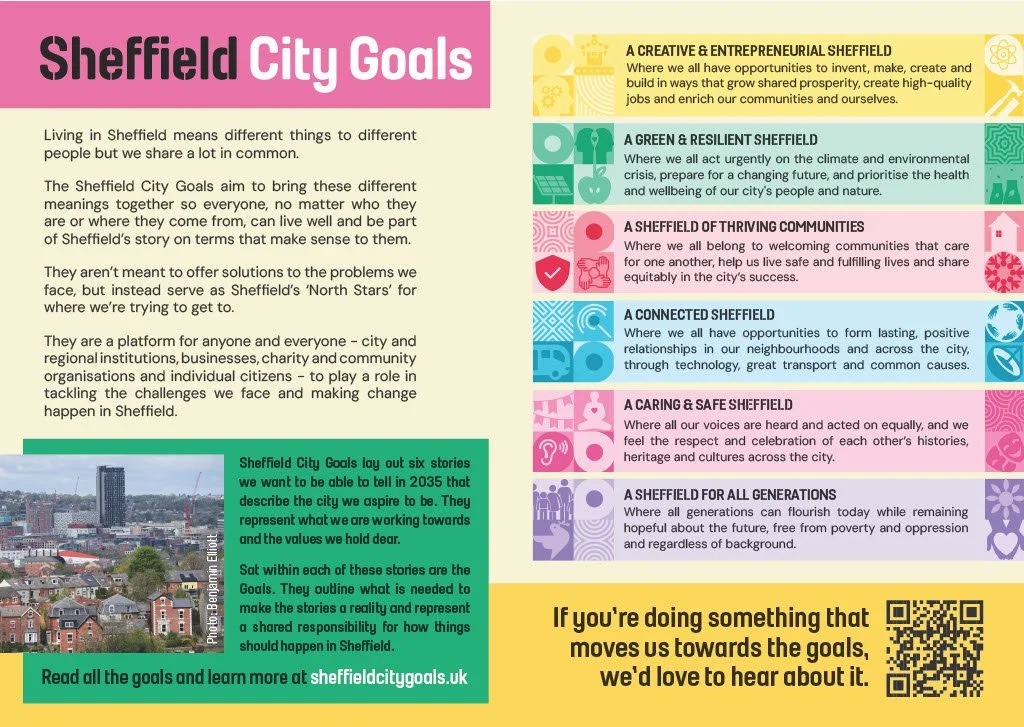
Sheffield is not starting from a blank page. The Sheffield City Goals give the city a shared set of aims and stories for its long-term future. Since the co-creation of the Goals with citizens across Sheffield, the city has developed a family of civic infrastructures around them.
Each does a different job:
Sheffield Stronger Together and its leadership group convene leaders across sectors around shared priorities. They’re now working to define the city-scale ‘Earthshots’ (ambitious, goal-oriented initiatives) that could bring institutions together to tackle Sheffield's biggest challenges.
The Partnership Lab builds organisations' capability to work together rather than through disconnected programmes. They will lead on the development of the Earthshots.
Neighbourhood Conversations create the conditions for people to develop shared understandings of the places they live, take collective action, and bring community insight and intelligence into their interactions with new civic infrastructures, existing public services and local government structures.
Metrics That Matter and Next Generation(s) develop civic and youth-led intelligence about what is changing and what matters. This includes approaches rolled out with schools via Learn Sheffield using SenseMaker, a storying tool that gathers qualitative and quantitative data about people’s observations and experiences.
The River Dôn Project and its Citizens' Observatory are building live environmental sensing and community observation across the River Don catchment.
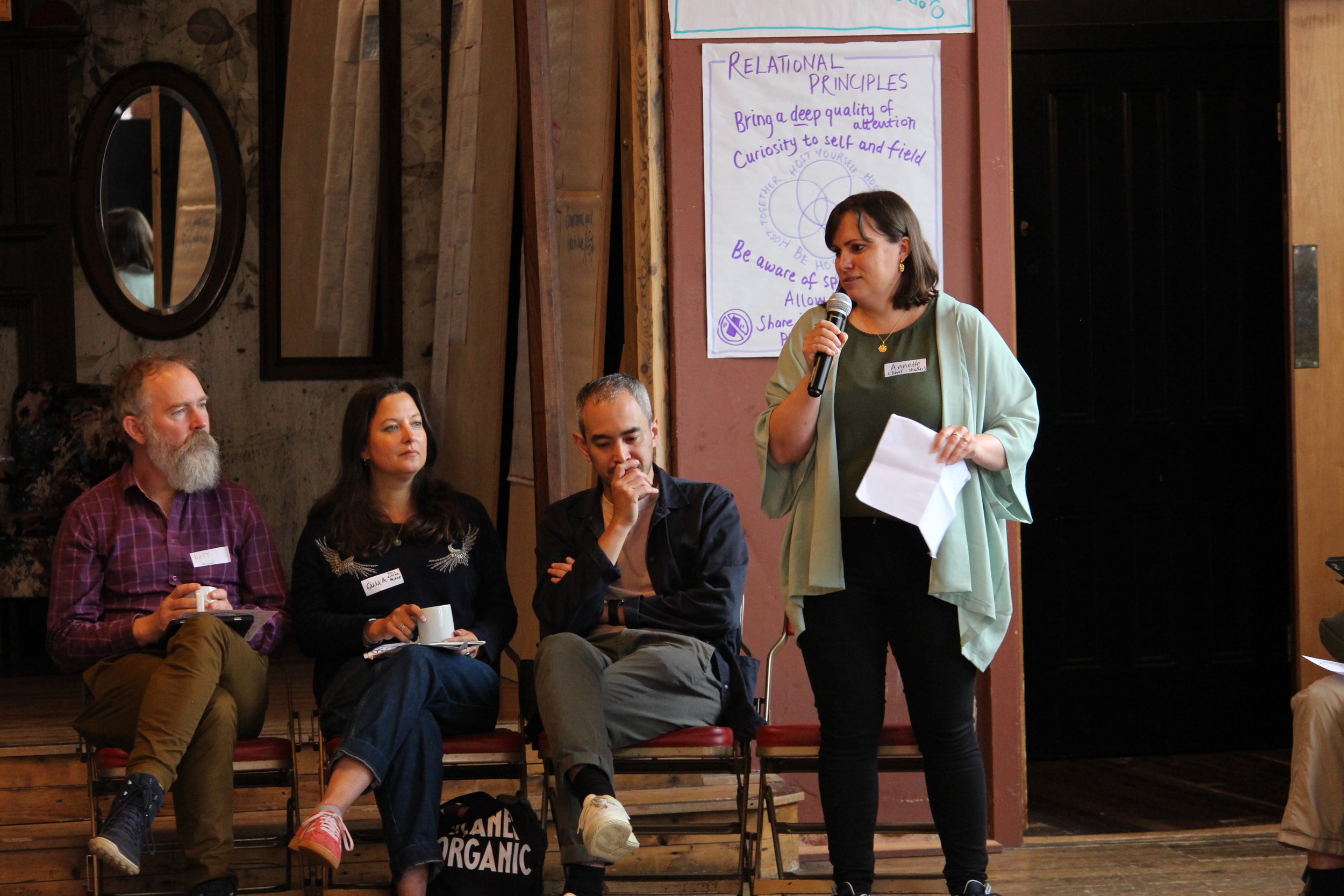
Much of our work in this space sits within Sheffield Transition Financing (STF), a collaboration which is being stewarded by Opus, DML, KeyFund, South Yorkshire Community Foundation and South Yorkshire Community Bank. This is a developing ecosystem that aims to help the city turn local priorities and the City Goals into real projects, funding and long-term change. STF works across nested scales of place, recognising both interventions and investment across the city, neighbourhoods and the wider bioregion are deeply entangled.
The neighbourhood level responds to a practical gap: very few governance or financial systems are designed for a neighbourhood of 4,000 to 5,000 people. Most funding is built to reach individuals, businesses, charities, large institutions or local authorities. The STF is testing whether lightweight neighbourhood governance and funds could let neighbourhoods identify priorities, steward resources themselves and shape local development, with a long-term aim of offering this across all the 147 of Sheffield's neighbourhoods.
At the city layer, the STF focuses on investment coordination, institutional alignment and shared outcomes. At a bigger scale, it is exploring how bioregional challenges such as flood risk and soil health could be financed.
None of these pieces is meant to work alone. Neighbourhood funds do not automatically create trusted decision-making. Capital does not automatically create strong local projects. Participation does not automatically open pathways into investment.
The point of the ecosystem is the quality of connection between its parts: whether, over time, they start to behave as a network that learns and reallocates, rather than a set of projects that deliver and end.
Building on the institutions Sheffield already has
Rather than create new financial institutions from scratch, we’re exploring how STF can build on organisations the city already trusts. These are early, open discussions. No commitments have been made, and the designs below may change substantially as conversations continue.
The reasoning is simple. A core motivation behind STF is to locate and develop financial capability inside civic systems, where today it barely exists. Community organisations understand local needs but struggle to reach investment. Investors and institutions have capital but lack trusted pipelines. Community finance institutions already sit between the two, with the regulation, relationships and local trust that would take a new organisation years to earn.
So who’s involved?
South Yorkshire Community Bank: We’re in discussion about whether the credit union could act as financial steward for pilot neighbourhood funds – the regulated home through which grants, philanthropy and investment reach neighbourhood level. We’re also exploring fixed-term deposit and retail bond models, which could let residents put their savings to work in their own city's transition.
Key Fund: We’re in discussion about investment-class bond structures, including the potential use of Community Investment Tax Relief, and about how social investment could help fund a neighbourhood outcome accelerator that turns local ideas into investable propositions.
South Yorkshire Community Foundation: We’re exploring whether the Foundation could provide a philanthropic gateway for corporate, high-net-worth and charitable giving into Sheffield’s neighbourhoods, working alongside South Yorkshire Community Bank. This could enable larger gifts to flow into neighbourhood funds hosted by the credit union, or into a Sheffield-wide fund, with appropriate charitable assurance while preserving neighbourhoods’ ability to decide what matters and how resources are used.
Voluntary Action Sheffield and Sheffield Social Enterprise Network: We’re working with both organisations to explore how the voluntary, community and social enterprise sector can play a stronger role in shaping Sheffield’s neighbourhood infrastructure, building on their relationships with grassroots organisations, communities and social enterprises across the city. This includes strengthening local capabilities, connecting organisations with wider resources and commitments, and testing new forms of partnership and agreement-setting that support more distributed civic action.
One idea we’re exploring is a blended civic investment pool, combining credit union and social investment approaches with guarantees and risk-sharing to lower the cost of capital. The kind of capital we’re deploying matters as much as the vehicle. The STF is not seeking speculative or extractive investment. Its focus is on civic finance, social investment, philanthropy, community finance and mission-aligned institutional capital. Neighbourhood priorities stay bounded by the City Goals and shaped through local governance – not set by whoever brings the money.
Outcome-based finance meets systemic risk
Many of the things a city needs most create real value but no straightforward commercial return. Flood resilience, preventative health, neighbourhood care and ecological restoration all fall into this gap. Outcome-based finance is one way across it: paying for verified results rather than activities, so that whoever benefits from an outcome can help fund it.
But conventional outcome contracting assumes the outcome is already known. The sequence runs: define, price, contract, deliver, monitor, evaluate. That works when you know what success looks like and can measure it, attribute it and put a price on it. But systemic risks break every one of those conditions.
The River Don as a test case
Flood risk across the River Don catchment is a systemic risk. It emerges from the interaction of rainfall, land use, drainage, infrastructure and upstream decisions across a whole catchment. It affects businesses, utility companies, public bodies, and households alike. And climate breakdown is only making it more volatile.
The problem is not a lack of data. Data exists, but it’s fragmented across organisations, formats and owners, and no single actor sees the whole system. Sheffield even sits in a coverage gap between existing Met Office weather radars. Insurance helps manage the financial consequences, but it doesn’t improve understanding of the underlying risk, and it works best when risks are predictable.
Acting alone, any one organisation pays the full cost for partial visibility and leaves the drivers of the risk untouched.
Discovery as a contractible outcome
Our response is to treat discovery itself as an outcome that can be funded, verified and contracted. Discovery here means the collective ability to sense changing conditions, integrate scattered information, interpret emerging risks and coordinate a response. You cannot contract for a reduction in risk you cannot yet measure. So the first thing to buy is the ability to measure it.
The first practical intervention is a WR-10X precipitation radar, delivered through the River Dôn Project's Citizens' Observatory. It will provide high-resolution, real-time rainfall monitoring and short-term forecasting across South Yorkshire, the Peak District and the Don catchment. The radar is not presented as a solution to flooding. It is the foundational layer of a wider ‘sensing stack, onto which river and water quality monitoring, urban surface-water sensing, catchment saturation sensors and community observation can be added over time, including new sensor networks being deployed across the catchment.
It also builds on what’s already there. The River Dôn Project has already assembled around £254,000 in investment and in-kind contributions. This includes the precipitation radar, a site and data connection from the University of Sheffield, an existing digital engagement platform, and project staff time.
Crucially, the discovery outcomes are specific and verifiable. They include foundational rainfall data made available, the radar commissioned with live data streams; a signed and executed outcome contract; and a second organisation joining the alliance. We release payment only when each discovery outcome is independently verified. We even treat the design of the contract as an outcome worth paying for, because turning a fuzzy risk into a repeatable, contractible instrument is real work with lasting value.
The Outcome Holders Alliance
If a systemic risk lands on everyone, it should be bought by everyone. Systemic risks require systemic collaboration, and the mechanism we’re developing is called an Outcome Holders Alliance: a consortium of organisations exposed to the same risk, jointly buying shared, verified outcomes that none of them would, or could, buy alone.
Early private-sector interest
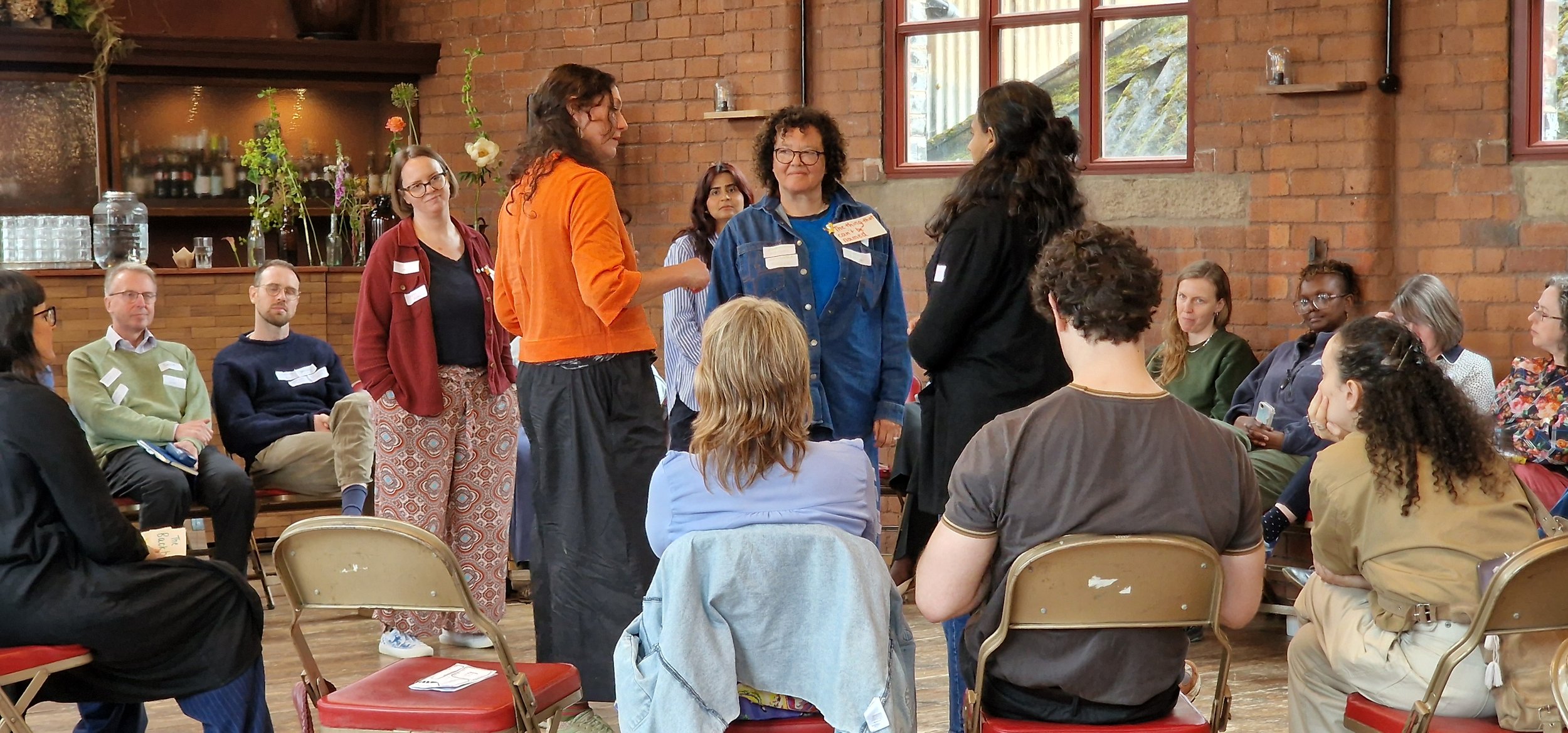
An important part of testing this approach has been working with organisations already exposed to the risks we're trying to address.
AESSEAL, a global manufacturing business headquartered in Rotherham, has identified flooding as a significant long-term risk affecting its operations, supply chains and workforce. Through an in-kind collaboration, AESSEAL, Opus and Dark Matter Labs held a series of workshops using the company's own risk register to explore how a discovery outcomes contract could work in practice, including how outcomes might be defined, verified and eventually priced.
This helped move the work from an abstract financial model towards something grounded in real organisational exposure, while exploring how a company's own risk management priorities might support investment in shared resilience across the wider catchment.
“As longtime neighbours of the River Don, we’re all too aware of the threat flooding poses both to our business and to the communities we serve, including our workforce. That’s why we were really excited to engage with this project, which offers the potential of addressing systemic value at risk in a completely new way.” — Martin McKervey, Director, AESSEAL
We're also beginning conversations with a major insurer about participation and the potential contribution of insurance-related risk data. This raises a further question: can organisations that traditionally insure against the consequences of risk also help invest upstream in understanding and preventing them?
For prospective anchor participants, going first offers a distinct opportunity. A fixed, cost-based contribution buys defined discovery outcomes, with payment linked to independent verification and no dependency on other members joining. In return, the anchor helps shape the first outcomes, verification standards and roadmap, takes an initial leadership role in the alliance's governance, and gains a first position in future outcome contracts. Because the infrastructure is shared, the anchor benefits from the wider system while funding only part of it. Crucially, it can test this approach without committing to the whole vision in advance.
Who else is at the table
The same logic applies to every organisation exposed to the risk: statutory flood and environment bodies, utility companies, the local authority, the health system, insurers and other large employers. Each would join because the shared capabilities reduce individual risks. Each brings more than money: data, operational knowledge, authority or legitimacy.
Contributions follow a few simple principles:
Negotiated, not formula-driven: Each member's share is agreed among members, guided by its exposure and expected benefit, and revisited as the alliance grows.
Additive, not discounting: The anchor's contribution stays fixed. New members' money grows the programme rather than reducing what earlier members pay.
Shared core, deeper access: Earlier warning and the shared risk picture flow to every member. Larger contributions buy depth, such as raw real-time feeds and asset-specific intelligence, and more governance weight, but never exclusivity.
No cross-subsidy: Later joiners pay for refinements and their own accession, not for work already delivered. Each outcome is paid for once, by the party that contracted it.
Governance and form
The alliance is governed by an Oversight Group: a working governance process rather than a sitting board. Made up of outcome-holder representatives and convened by STF, it validates that outcomes have been delivered (supported by an independent verifier), sets priorities, agrees pricing approaches and oversees data access, with core products open by default.
We’re intentionally flexible about the alliance's legal form. It could start with simple bilateral outcome contracts. As members join, it formalises into a coordinated consortium under a multilateral memorandum of understanding, which creates no financial obligations and no joint liability. Only once membership, evidence and legal comfort allow would it move towards a pooled outcomes fund.
That end state follows the logic of Advance Market Commitments, which have shown that pooled buyer commitments can create markets for outcomes nobody buys alone. Gavi's $1.5bn pneumococcal vaccine commitment in 2009 and Frontier's $925m+ carbon removal commitment in 2022 are the best-known examples. The alliance applies the same logic to flood-risk outcomes: pooled demand makes investable what no single buyer could justify.
Pricing what we cannot yet see
Discovery outcomes are priced at cost today. Flood-risk reduction outcomes will be priced against the value at risk they reduce, once discovery makes that measurable. No one is asked to pay a "discovered" price for something that cannot yet be defined, measured or attributed.
Every outcome sits between two bounds. The floor is what it costs to deliver. The ceiling is the value at risk it reduces, which sets each holder's willingness to pay. As discovery reduces uncertainty, the basis for pricing moves from the floor towards value.
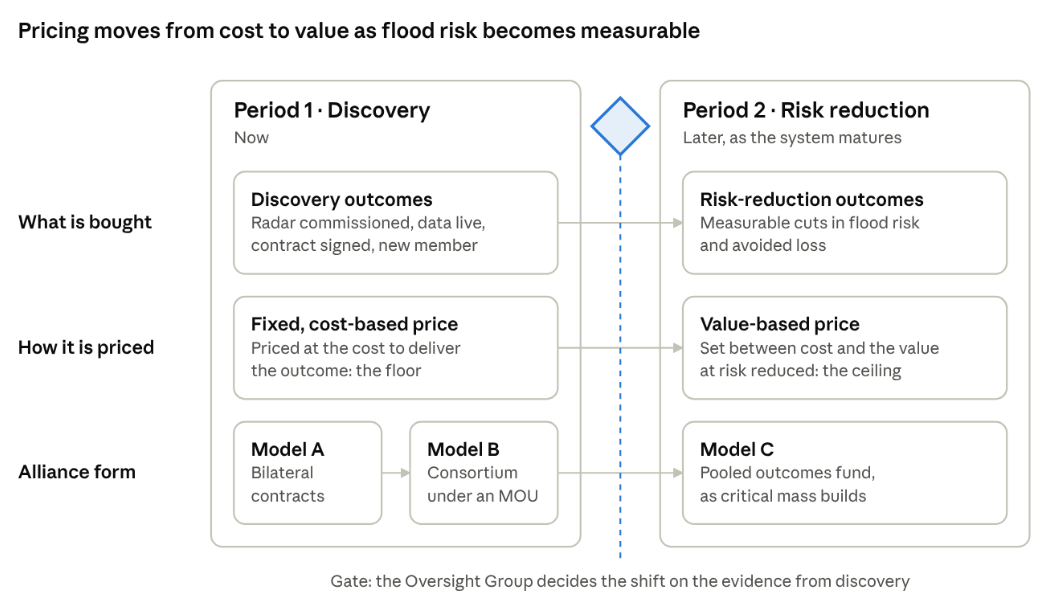
Each period contracts a different kind of outcome. Joining the second is a separate decision for every member, taken on the evidence the first produces.
The pricing foundation has six building blocks. The discovery work stands up the first three, and the alliance develops the rest as evidence accumulates.
Outcome definition: turning "better understanding" and "lower risk" into specific, verifiable statements.
Measurement and baseline: the observatory provides the data pipeline and the pre-intervention baseline.
Attribution: separating value genuinely created from what would have happened anyway, so holders pay only for marginal value.
Value anchor: each holder's value at risk, and the share an outcome reduces, sets the ceiling.
Cost basis: what it costs to deliver the outcome sets the floor.
Price formation and sharing: a price between floor and ceiling, shared across holders in proportion to benefit and released only on independent verification.
Value at risk is itself part of the discovery. Flood exposure runs through operations, supply chains, workforce access, infrastructure and financing costs, often indirectly. Establishing a baseline value at risk, with a defined time horizon and confidence level, is an outcome of this work rather than a precondition for starting it.
This is a foundation, not a formula. The detailed mechanics, from metrics to attribution method to sharing rule, will be developed inside the alliance as the evidence arrives to set them credibly.
What we’re learning through this work
The work is at an early stage, but a few lessons are already shaping how we approach it.
Start with discovery: Systemic risks cannot be priced before they’re understood. Treating discovery as the first contractible outcome lets outcome-based finance begin much earlier than it otherwise could.
Start concrete and contained: A ring-fenced first pilot, with fixed costs and verified outcomes, lets organisations test the collaboration model at low risk. They do not need to sign up to the whole vision to take the first step.
Treat flexibility as a design choice: Moving from bilateral contracts to a consortium to a pooled fund only as trust and evidence build keeps the structure honest about where it actually is.
The logic travels: The same approach could apply wherever prevention reduces future costs. Through STF, we’re also exploring how public bodies could act as outcome purchasers or guarantors in areas such as public and neighbourhood health, and how city-scale ‘Earthshots’ could convene outcome holders around shared priorities and critical complex problems.
Plenty remains unresolved. How do we attribute risk reduction fairly when many actors and interventions are involved? How should value-based prices be shared across outcome holders with very different exposures? How do civic voices, not just the organisations with money, carry real weight in the alliance's governance? And how do neighbourhood-scale outcomes connect to city and bioregional ones?
We do not see any of this as arriving at a finished alternative system. It is transition infrastructure: a way to move from systems structurally locked into the status quo toward different possible futures.
The real test is whether Sheffield's civic infrastructures start to behave as networks that learn and reallocate, rather than projects that deliver and end.
If your organisation is exposed to flood risk in the Don catchment, or you’re working on similar questions about outcome-based finance for systemic risk elsewhere, we would like to hear from you.