

We recently heard the exciting news that Sheffield has been shortlisted to become the UK’s next City of Culture in 2029, and here at Opus, we were proud to work on our bid as Lead Engagement Partner. What we learned didn’t just go into the bid – it helps us understand what people value about Sheffield, the experiences that create meaning and belonging, and the wider opportunities culture can create for the city.
In this series, we’re sharing seven ‘signals’ from the full engagement report that we heard loud and clear, giving us a snapshot of our city’s culture sector and where people would like to see it grow and develop in future. Last week, we looked at how culture in Sheffield spans from the grassroots to the global. This week, we’re looking at how how we can build a city where creativity can flourish.
You said…
What is the most memorable event, festival, celebration or community activity you've ever been part of that made you feel connected to Sheffield? What made that moment matter to you?
“Tramlines is a brilliant annual festival to have in Sheffield's calendar”
“The Lunar New Year festival”
“Kelham Pride. I am a proud gay man and love the fact that a group of residents in Kelham decided there was a space for the LGTBQ+ community to thrive.”
“Migration Matters Festival is in my opinion the best festival in Sheffield – not just the opening and closing parties and how inclusive and diverse they are, but the quality of musicians, performers and events. It opens your eyes, helping you to listen and learn from different cultures”
“The Women's EUROs and the launch in the Peace Gardens.”
“The mass protest around the Town Hall when the local citizens rose up to defend our street trees – we still have that yellow ribbon displayed in our living room”
“The World Student Games were pretty special. But my favourite is going to as many of the Classical Sheffield weekend festival events as I can possibly squeeze in and loving every minute of the varied programme. Seeing and hearing such talented, dedicated and passionate music-makers come together to present wonderful performances is very heartwarming and pretty unique”
“Peddler Market – everyone is happy and relaxed, good choice of food and drinks, nice craft stalls, and good music”
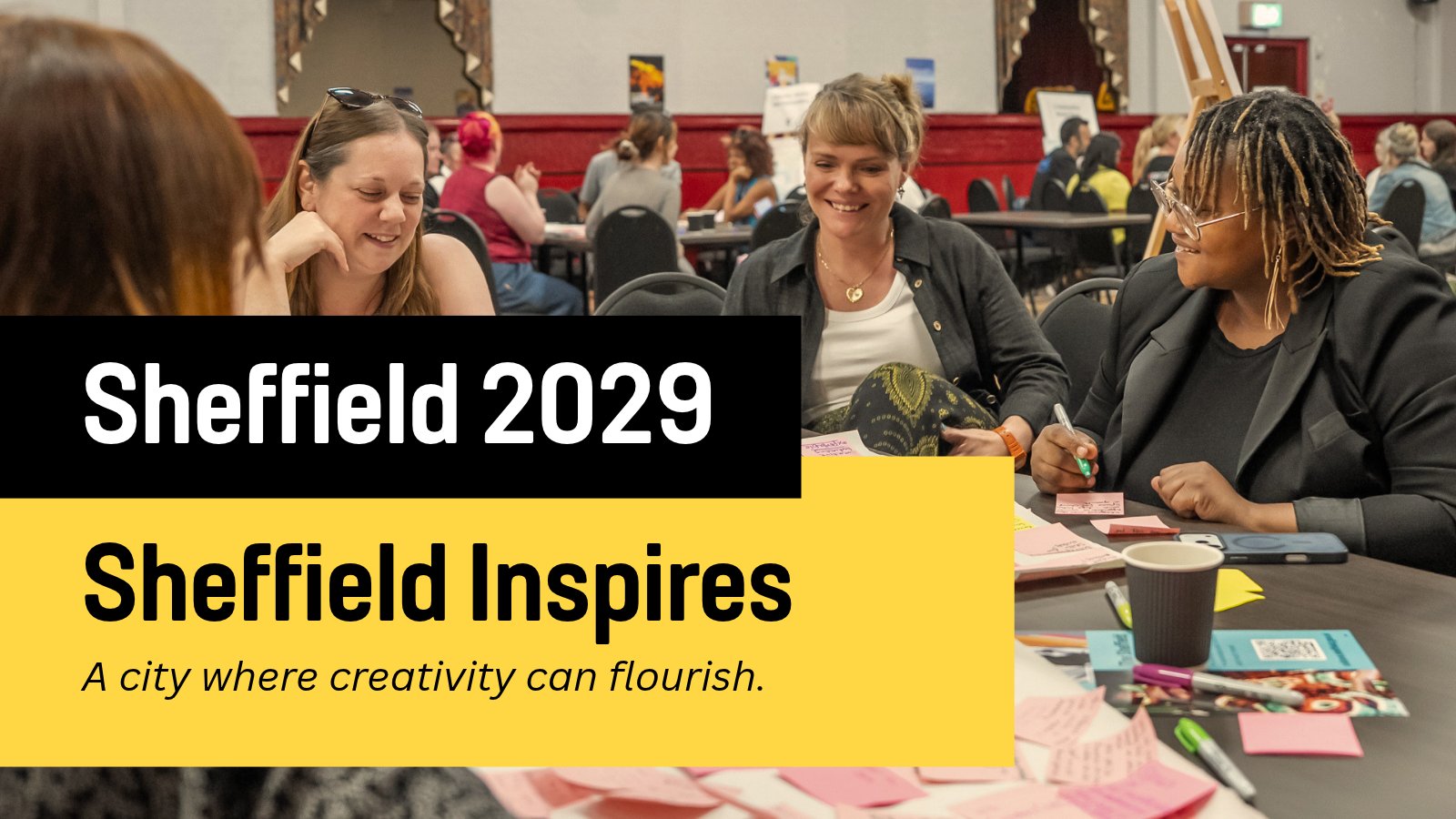
Sheffield Inspires
A city where creativity can flourish
Sheffield's cultural life is sustained by an extraordinary range of artists, makers, freelancers, organisations, festivals, venues and creative businesses.
The engagement revealed pride in this ecology and an ambition to see it flourish. Our City of Culture programme must create opportunities to make the most of the huge range of talents and skills of freelancers and independent artists, as well as our larger institutions.
Conversations with cultural leaders and practitioners explored the opportunities created when artistic talent, education, enterprise, community organisations and creative industries are better connected.
Participants imagined a city in which creativity is recognised not only as a source of enjoyment and identity, but as a meaningful part of people's working lives and Sheffield's future economy. One to one interviews with the city’s cultural and civic leaders expressed a need to invest deeply in infrastructures that can increase the capacity of the city to connect and collaborate as a key priority. This type of infrastructure was described as being foundational to develop the capabilities and capacities needed for city scale transformation through arts and culture. This priority is already clearly articulated already through the city’s Cultural Strategy and new governance structures such as the Culture Strategy Action Group but these interviews expressed a need to weave this principle throughout our City of Culture bid as well.
Sheffield is a city of creative talent. Participants celebrated the quality and diversity of artists, makers and cultural practitioners already working in Sheffield. The city's independent character and collaborative traditions were frequently recognised as strengths.
‘We have so many visual artists and so many studio spaces here but not much exhibition opportunities. Let’s get art in unusual spaces - the London underground artist posters for stops were brilliant, let’s get artists making tram stop posters. Let’s use spaces a bit more imaginatively away from the usual galleries”
Public survey respondent, July 2026
Creative opportunities should support people throughout their lives. The engagement highlighted the value of opportunities to explore creativity, develop skills, gain experience and build sustainable creative careers across emerging, mid level and established artists. A City of Culture programme needs to help create a pipeline of consistent opportunities across the city’s creative ecology.
Collaboration can help Sheffield's cultural ecology thrive. Interviews and group conversations pointed towards the benefits of stronger connections between artists, organisations, education providers, businesses and communities. These relationships can create opportunities for shared learning, new ideas and artistic development.
Sheffield's making heritage remains relevant to its future. The relationship between creativity, manufacturing, design, technology and innovation offers a distinctive opportunity for the city. Respondents imagined contemporary collaborations that connect Sheffield's industrial identity with new visions of the city we could become. This is expressed in the bid through international cultural exchanges with other cities that share our histories of making and have reimagined themselves in different ways. We also have a large, innovative and growing creative digital and tech sector that is not currently as integrated into publicly funded culture and community programmes as it should be. Our City of Culture programme will seek to make those connections.
Public survey responses showed enthusiasm for opportunities to encounter artists at work, participate in workshops and discover the processes behind creative production.
One respondent imagined artists collaborating with steelworkers, engineers, musicians, architects, digital creatives and landscape designers, connecting Sheffield's heritage with its contemporary creative identity.
The engagement points towards a Sheffield in which creativity is increasingly visible as a source of personal opportunity, artistic excellence and economic growth.
People want a city that celebrates its creative talent, supports new generations of practitioners and connects cultural activity with wider opportunities for learning, innovation and employment. The aspiration is for Sheffield to be recognised as a place where creative people can develop their ideas, find collaborators, build careers and contribute to the city's future.
Next week, we’ll look at how Sheffield’s cultural future can be shaped by the next generation. You can read the full engagement report now.