

We're looking to model new forms of neighbourhood democracy here in Sheffield – and we're thinking about where to start
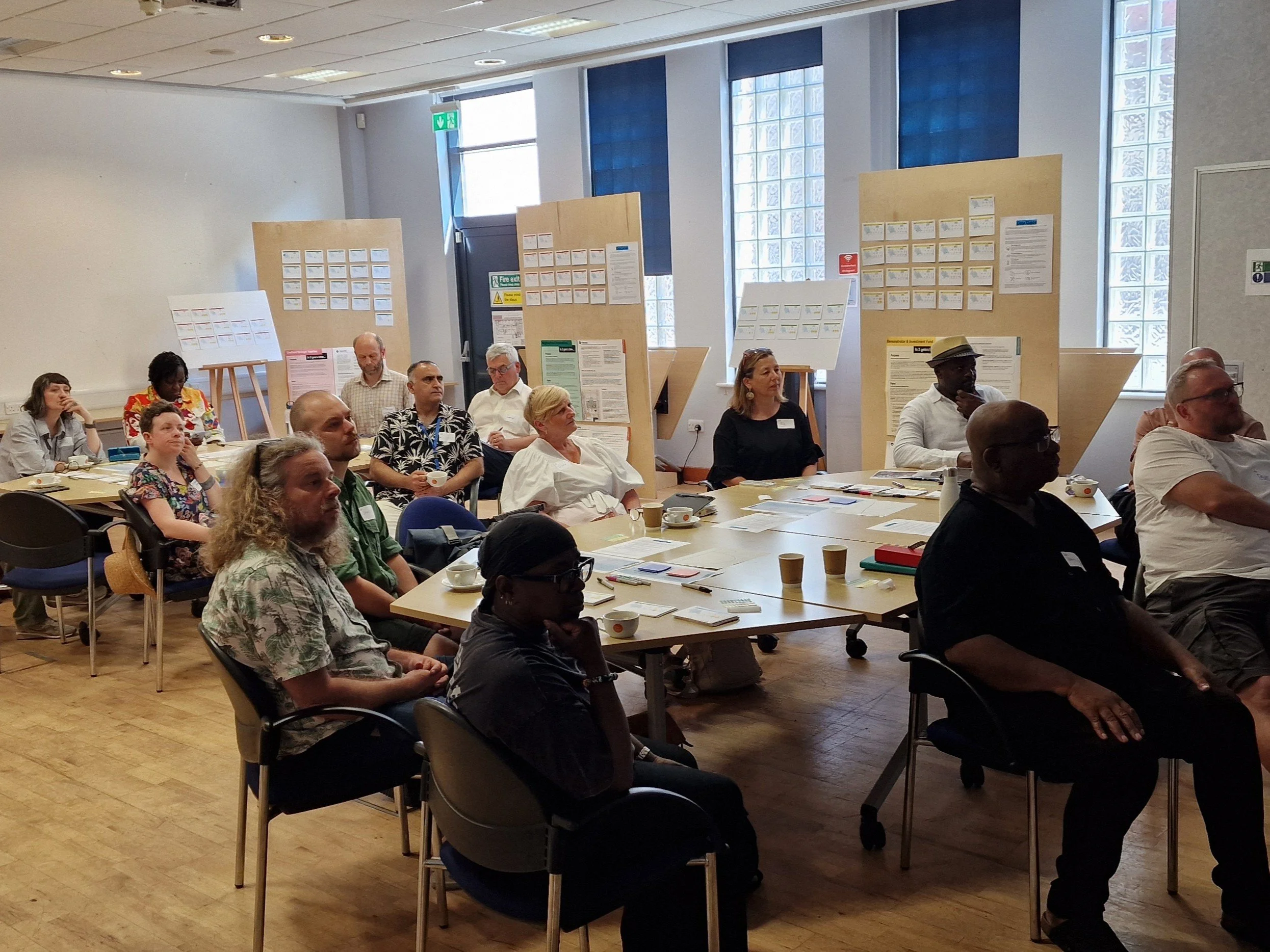
On 26 June, we welcomed representatives from Sheffield’s voluntary and community sectors to the Circle and invited them to take part in a unique exercise. We looked at neighbourhoods across the city and asked them to select a starting set to invest in, as a demonstrator for what new forms of neighbourhood democracy might look like.
This followed on from our earlier sandbox exercise, held with a smaller group of people already involved in Sheffield Transition Financing (STF). In that workshop, we explored how and where we could start supporting Neighbourhood Conversations in the city, as a first stepping stone towards local decision-making and governance of Neighbourhood Funds.
We gained really valuable insights from the first group, and were keen to expand on this with a larger group. Our second group was made up of people from a wider range of organisations across Sheffield – some very local, some city-wide – who were mostly new to STF.
We encouraged our participants to think about two questions:
What should we be looking for in our starting set of neighbourhoods?
How do the many neighbourhoods of Sheffield sit within that framework?
The big challenge has been the breadth of information we need to consider to fully engage with these questions.
We’re using Citizen Network and Data for Action's neighbourhood map of Sheffield, which frames the city as being made up of neighbourhoods of roughly 4,000 to 5,000 people. We’ve already shared why we think that's a valuable way of thinking about Sheffield. That means there are 147 neighbourhoods in Sheffield, and each one has an enormous depth of character, history, needs, strengths, and energy – and it’s all changing constantly.
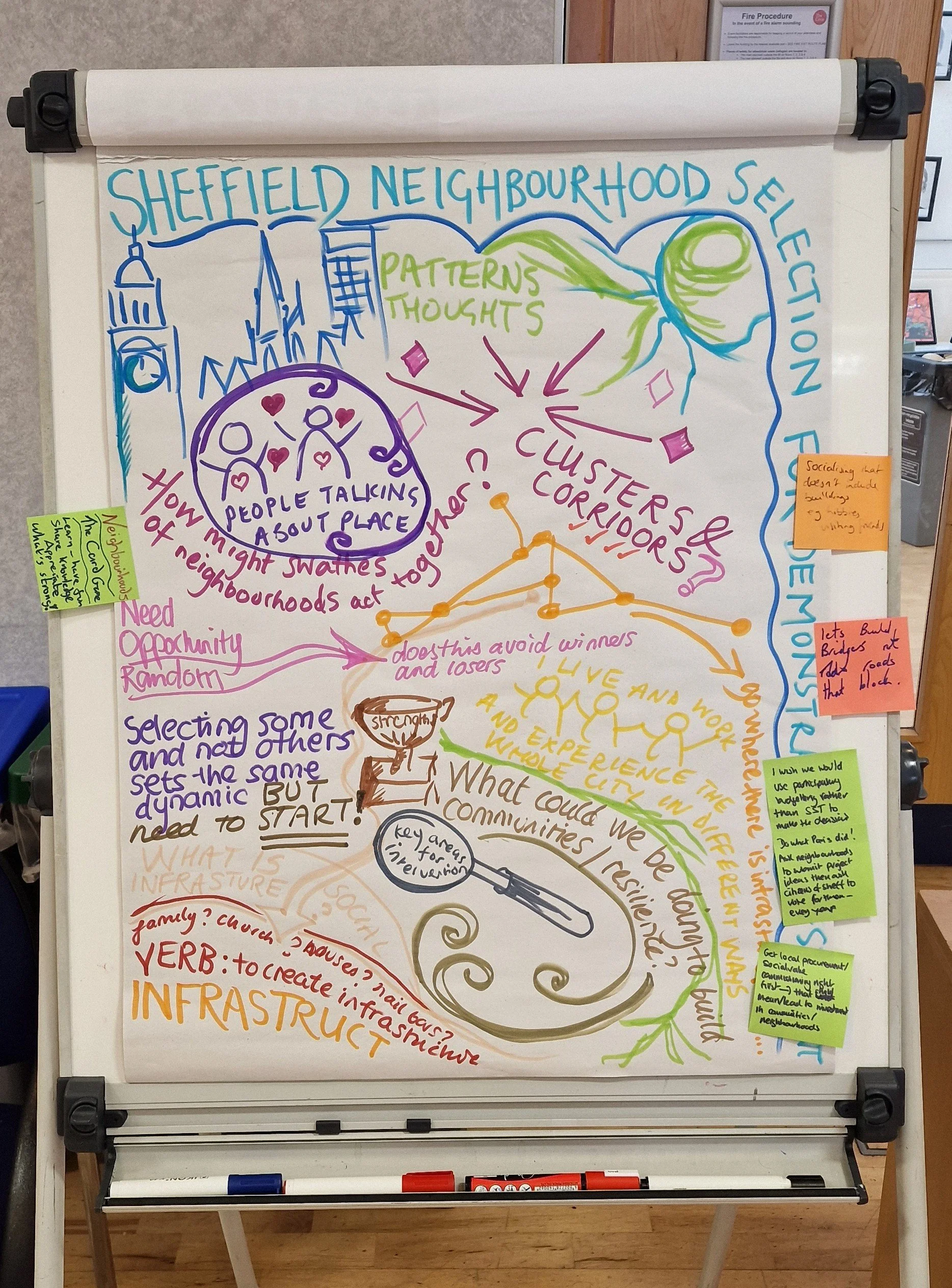
How can any one group hold all of that complexity, and use it to create a portfolio of ‘starter neighbourhoods’ that reflect the ambition and potential of the city?
We approached this problem from two angles – a quantitative and a qualitative one – and both came with unexpected challenges. We also wanted the workshop to be practical, and to give participants the chance to process the information we gave them in a tactile way, as well as by reading and analysing.
We first set about collating lots of hard data about the city and placing it within the framework of the 147 neighbourhoods. We drew from some well-known datasets, like the Indices of Multiple Deprivation and the Environment Agency's flood risk maps, as well as from exciting newer projects like the fantastic Carbon & Place and Transport-Related Social Exclusion.
We printed out large maps of Sheffield overlaid with this data, allowing participants to see the patterns and confluences of different features across the city. We also created 147 cards, one for each neighbourhood, that highlighted a few key stats as well as the location within the city, to help participants quickly compare neighbourhoods and intuitively assess the geographic spread of any given group of neighbourhoods.
Producing the maps and cards was a really fun challenge. It lay a little outside the comfort zone of our team, and I got to spend a fantastic few weeks learning new skills, software tools and methods of data manipulation to bring it all together – then a few days documenting everything so I don't have to re-learn next time! We're very grateful to the various people outside Opus who helped us find the data we needed and access it in a way that helped us use it effectively.
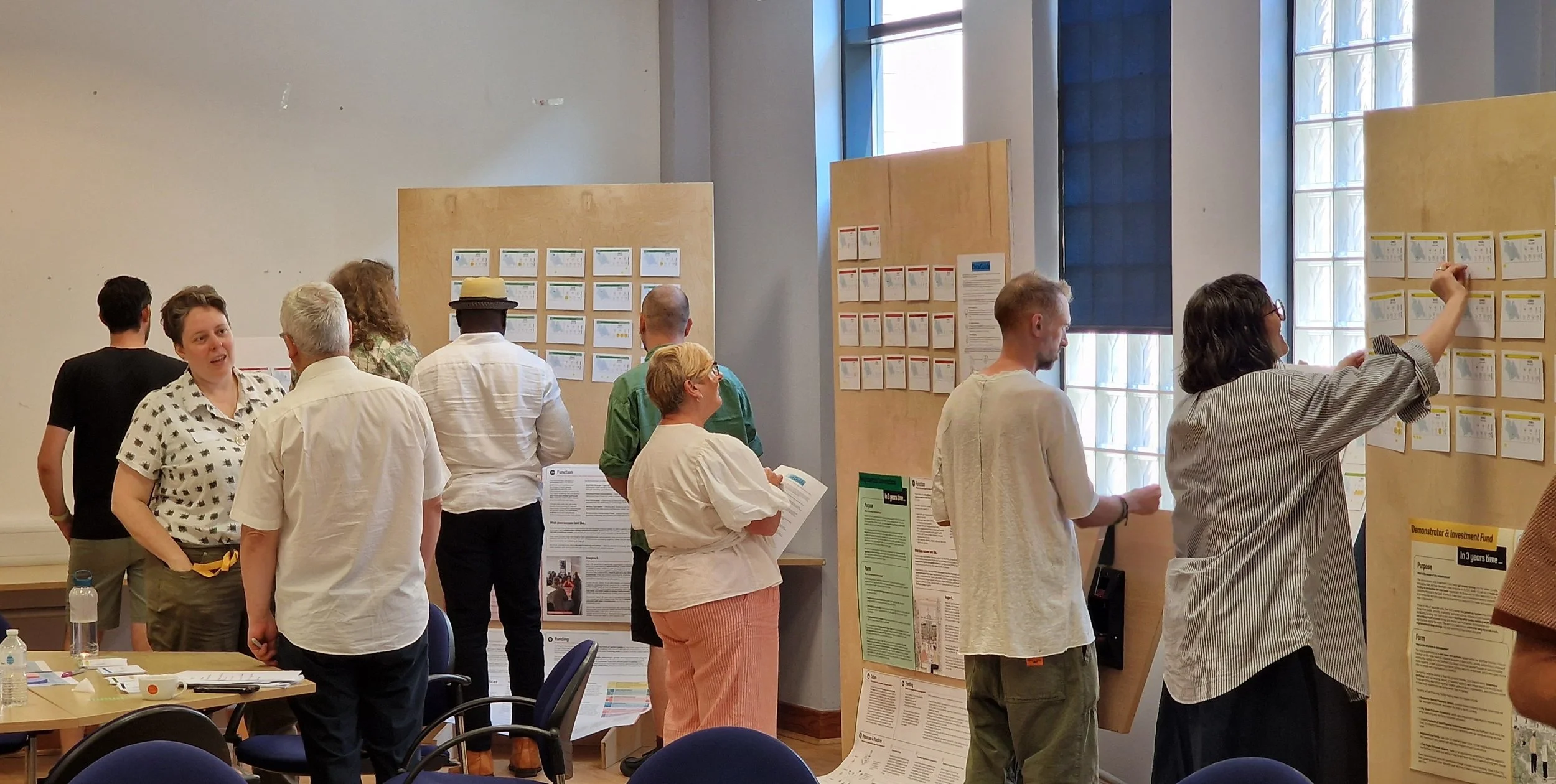
Although the datasets were useful, they presented a very partial picture of the city, and one that many participants understood as reflecting weakness and need rather than strength and opportunity. Relatively few of the datasets we sourced did a good job at representing strengths, and some of those that did were less methodologically rigorous than we’d have liked. There were some significant gaps that we couldn't fill at all.
From a qualitative perspective, we tried to bring in as diverse a range of perspectives as possible into the in-person workshops, taking advantage of the knowledge and local understanding of people from across the city. We're also really excited about the Learn Sheffield Cynefin SenseMaker that will be run in schools later this year and would love to have used it as part of the process, but unfortunately the timescales didn't line up.
We had the privilege of hearing lots of nuanced and thoughtful discussion about the different neighbourhoods of Sheffield – where things are happening, where people are building things together, and where conditions are shifting in ways that don't show up in any dataset. We asked participants to tell us who they would talk to first if they were starting work in a place, and they came up with a huge list of contacts – an incredibly valuable resource for us.
Following each workshop, we brought together the themes of the discussion, any points raised that we as a team hadn't previously considered, and the neighbourhoods that participants thought could be fruitful places to start. It was really interesting to see that the two groups tended to focus on quite different themes and priorities, but also produced overlapping sets of suggested starter neighbourhoods.
Our first group was drawn mostly from people who work in the social funding space, and they were keen to avoid replicating the same dynamics they’ve seen before. They didn’t want to focus solely on more deprived areas, pointing out that one of the strengths of the STF approach is that it has the potential to build city-wide change out of neighbourhood-level work, regardless of which neighbourhoods that work begins in.
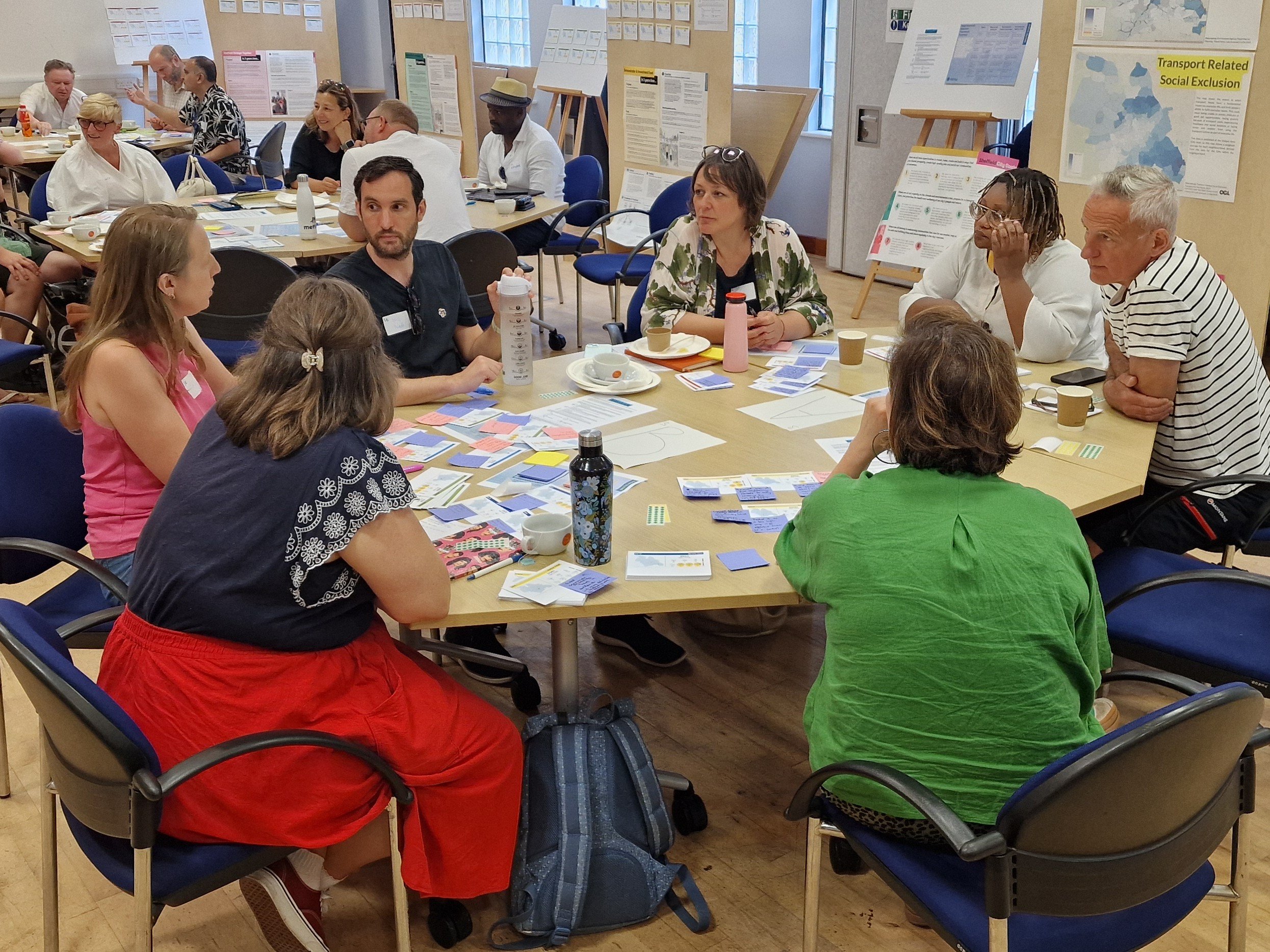
Our second group was much broader and included people with a diverse range of backgrounds, and they were keen to see STF start in places that have experienced lots of failed or temporary interventions, as well as to understand the ways that neighbourhoods can work together and influence each other by clustering our starting points together geographically. They also generally felt that it was worth targeting more deprived areas.
Both groups wanted to start in places where there are already groups and individuals working in ways that could complement and compound the benefits of the STF approach, as well as areas with a strong and distinctive story, or which are in some way disconnected from the city as a whole.
Another discussion topic was how STF could or should connect to existing large-scale local investment – and how the interaction of two very different sets of values, attitudes and practices might play out, both as an opportunity and as a risk.
Despite the differences in approach, there was a lot of overlap in the places both sets of participants thought would be good starter neighbourhoods. This process has been hugely valuable, and the insights produced – both on where to start, and more significantly, why – will inform the development of delivery plans for STF and the other City Goals infrastructures.
We're fortunate to have new people and organisations getting involved in this work all the time, and the enthusiasm and commitment we're seeing from all quarters is remarkable. People across Sheffield are ready to get stuck into a new way of building our shared future, and we’re in an exciting moment of gathering, nurturing, and being constantly surprised by what's emerging.