

In a story commons, the process is the purpose
This piece is part of our ‘Lessons for a Story Commons’ series. These lessons emerged from a group of creatives who gathered to share examples and prompts for shifting the way we tell stories. Read more about this process, and the transition we’re working towards, in our introductory piece.
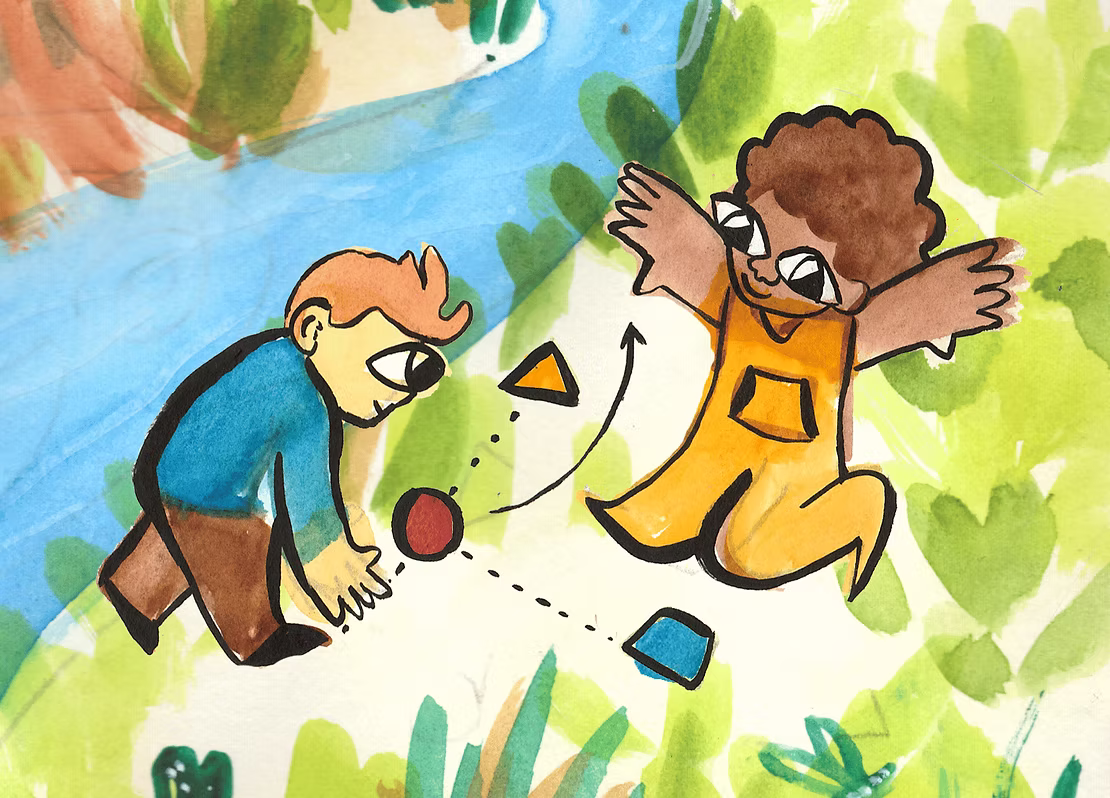
Illustration by Charlotte Bailey
As individuals, communities or organisations, we are constantly assigning – or perhaps more often, assigned – value. We are weighed and measured every second, every hour, every day, in almost all our interactions.
This supposed ‘value’ is largely attached to objects or characteristics rather than processes or relationships. As individuals, that value (or lack of value) may be attached to our accents, our clothes or our job titles. As organisations, value is assigned solely to outputs – so for those of us in the business of telling stories, our worth might be judged on an article, a theatre production or a piece of music.
But those final artefacts are not the whole story – they’re not in themselves a complete piece of work. In fact, they represent a fraction of the impact that a story makes on the world. They are just one moment in the wider ‘story of the story’, which includes the processes and relationships which inspired and generated the story, the physical, mental and emotional connections developed during the production of the story, and the change the story will make once it goes out into the world.
All of that is self-evident, and highlights how the judgements that are being made about us, and our work, are partial in every sense of the word. They’re partial in that they’re made on the basis of incomplete information, but also partial in that they privilege a particular conception of the world which values products above relationships, or clicks, likes and shares above meaningful or genuine connection.
Yet this way of thinking about the world has acquired a powerful, persistent and pernicious hold on our systems. That’s largely through an over-reliance on ‘metrics’, and very often the wrong ones. A quote often attributed to Einstein, but now more often credited to the sociologist William Bruce Cameron, “Not everything that can be counted counts. Not everything that counts can be counted,” powerfully captures this.
Work created by and for marginalised people and communities is judged against work created by and for those with access to money and power. But, of course, not on the same terms – work that centres marginalised voices is judged on terms decided by those who already have access to privilege, and therefore have a vested interest in hanging on to it.
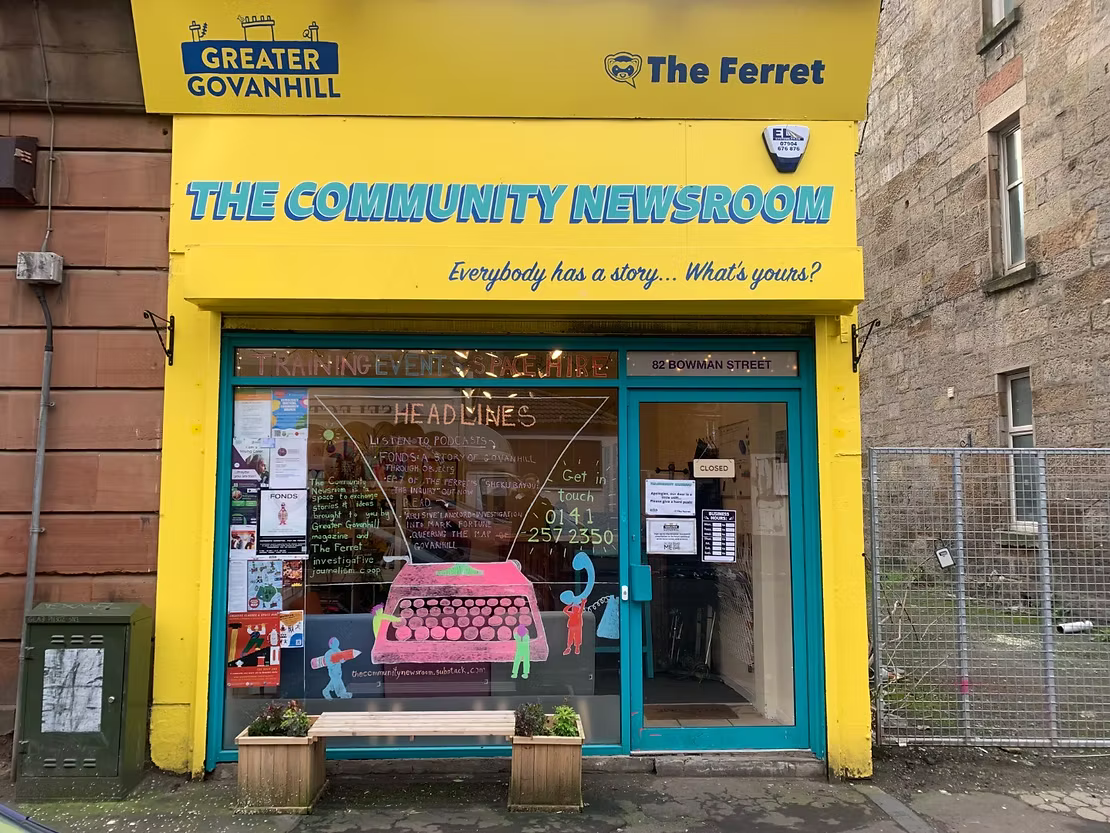
Greater Govanhill's Community Newsroom
Stories that bring people together ‘perform’ worse than those that drive people apart. We insist on celebrating, awarding or fetishising individuals, despite the fact that every achievement in human history has been enabled, supported or facilitated by people working collectively. Stories that could make our lives safer, healthier, more connected, or simply better are deemed less valuable than stories that make our lives worse.
What this value misallocation leads to is resource misallocation. Time and money continue to be wasted, even by supposedly progressive governments, organisations and funders, because they’re being told the wrong stories. To build a future we want to live in, we need to rethink where and how we see value.
Central to that is recognising that the process is a purpose. If we can inspire, build and support transformative and lasting kinds of relationships through our work, surely that is more valuable than a transient or ephemeral ‘object’, such as a single headline?
In a storytelling commons, the relationships and processes that inspire and generate a story, as well as the effect that story has in changing the world for the better, are brought to the fore. In doing so, we also capture and highlight the collective nature of all of our stories, as well as the responsibilities that storytellers have when they hold our stories.
Greater Govanhill, a community magazine in Glasgow, has built a highly communal process. Stories for its bi-monthly publication are written by and with members of its community, and cover topics chosen collectively through member meetings and feedback. Some of that is facilitated by its Community Newsroom, a physical base which gives the magazine a presence in the community which can be seen, touched and perhaps most importantly, ‘felt’.
Where process itself is valued, the importance of those intangible feelings is magnified. In a world where the collapse of ‘trust’ feels existential, spaces where people are welcomed, listened to and given a platform to express themselves will help all of us feel in connection with ourselves, our communities, wider society and the world.
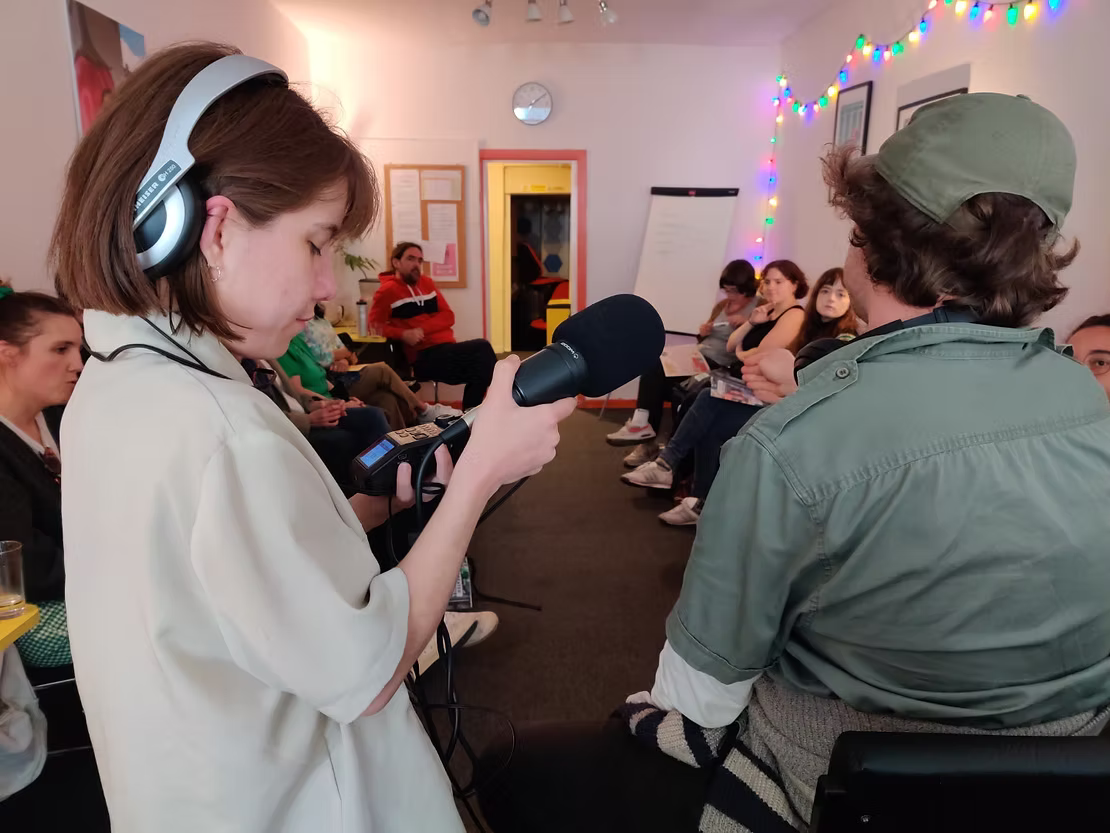
Recording in the Community Newsroom
For that reason, Greater Govanhill focuses on knowledge and skill-sharing. On one hand, it supports its community with the practical tools for members to share their stories. On the other, it learns from their experiences and those insights are absorbed into the ‘consciousness’ of the magazine. The magazine only reflects one part of that value exchange, but it’s felt and understood by everyone connected through those processes.
Similarly, National Theatre Wales’ collaboration and engagement hub, TEAM, reimagined how theatrical work could be understood, made and measured. In most theatre-making, producers and directors decide what they want to make and then get on with it. People and communities only get to engage with the final product for an hour or two, as a passive audience.
TEAM felt that wasn’t enough, believing instead that a different kind of value, and different values, could be unlocked by prioritising process and engaging deeply over the long term with communities.
Go Tell The Bees, was a four-year film project made by, with and for the people of Pembrokeshire. Unlike a traditional theatre production (or most storytelling processes), it started with little idea of what the final product would be. It was far more interested in what could be created by deeply connecting and deeply listening with people and place. TEAM’s projects start by asking communities what matters to them, what stories they want to tell about themselves and how. There is not just one output, but instead a range of outcomes and ongoing legacies.
What Greater Govanhill and TEAM have delivered are not simply articles, podcasts, plays or films. They are far more than that. They are connections, relationships, questions, answers, problems, solutions and – perhaps most importantly – change.
That often takes the form of tangible change in the outside world – initiatives or policies that respond to the themes that these collective processes have explored. But more often these are more subtle, but no less important, changes in how everyone involved engages with each other and the world: every second, every hour, every day, in almost all of their interactions. A different set of judgements have been made – judgements that working together, being ‘in common’ can help build a future fit for purpose.
Questions we’re asking now:
What might be possible if what storytellers created was focused on what it made their communities feel rather than what we think they should know? – Megan Lucero
I’m wondering how we reconcile valuing the process in this way with the need to ‘show’ what we’ve done to people outside of that process, for example to funders. What happens when they don’t value the process like we do? – Debs Grayson
This piece is a reflection of the learnings and insights shared in dialogue with the People’s Newsroom community. It was curated and written down by Shirish Kulkarni and shaped by Debs Grayson and Megan Lucero, edited by Sam Gregory, and produced by Phia Davenport.
This piece is part of a series, Lessons for a Story Commons. Aside from the introduction, How storytelling can open the door to thriving futures, the series can be read in any order: