

In a story commons, we collaborate to regenerate
This piece is part of our ‘Lessons for a Story Commons’ series. These lessons emerged from a group of creatives who gathered to share examples and prompts for shifting the way we tell stories. Read more about this process, and the transition we’re working towards, in our introductory piece.
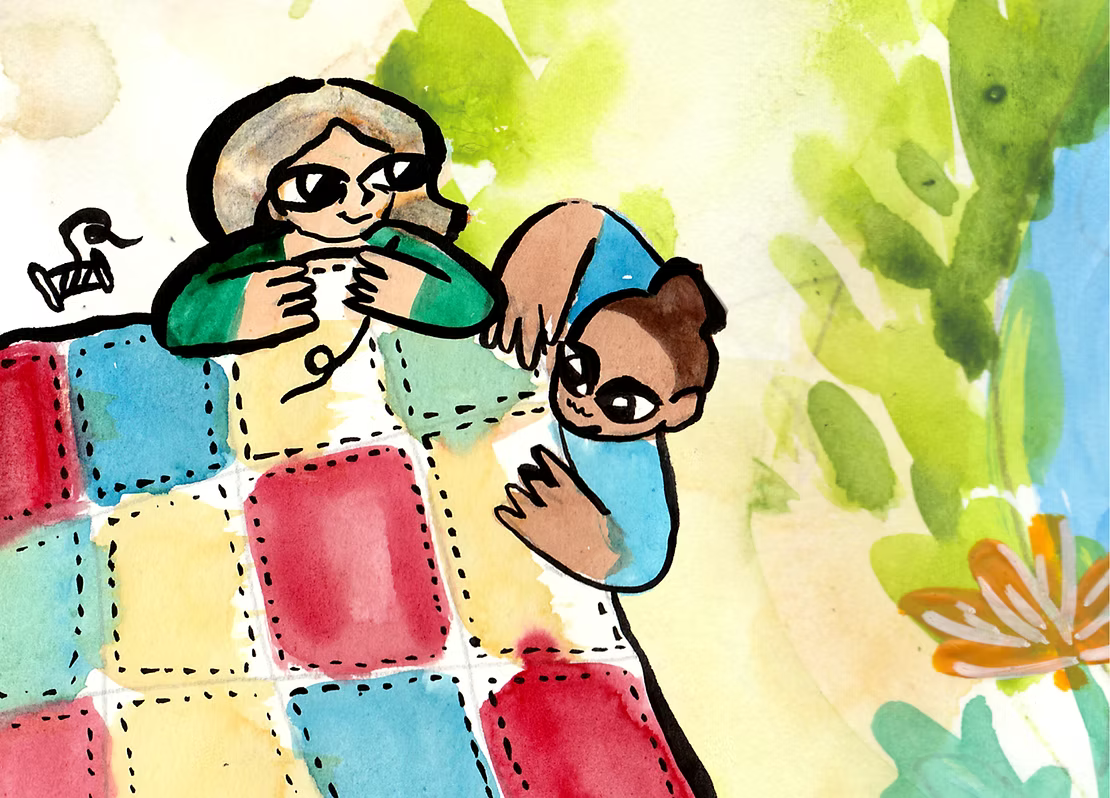
Illustration by Charlotte Bailey
The work of the People’s Newsroom centres on the hope that we can imagine, develop and steward a Story Commons which will help us tell deeper, more systemic and ultimately more valuable stories. These stories would reflect and enable our essential interconnectedness and our innate need for connection, solidarity and collective action.
This is not a particularly radical mission: it simply reflects how our ancestors instinctively understood the power and purpose of storytelling. Stories were a way to help us navigate a safe course through the world, and share information in an accessible and engaging way. Crucially, this was often information that could make our lives better or even save us.
We see this clearly in fables, fairytales and even scripture. While of course these kinds of stories are open to their own critiques, they do at least have a clear and engaging purpose rooted in helping us figure out how we want to live our lives. They speak of morality, courage and resilience. They highlight the importance of kindness, honesty and commitment, and demonstrate that danger and adversity can be overcome.
Critically, these are not stories about individuals in isolation, separated from any social context or prioritising their own self-interest. These are all stories about how we relate to each other – how we create and maintain the bonds between us. These are stories of and from the commons. They highlight that commoning is in fact a highly intuitive way of living and that, despite it providing the instinctive framework for many of the ways we all think and act, it can simultaneously feel like an impossible dream.
These stories from the commons help us understand the world, locate us in our environment and interact better with it. They’re stories that help us form views and make decisions that are in the interests of ourselves, our families and our communities. We could argue that they’re stories that in many ways fulfil the core purpose of journalism – but the storytelling ‘industry’ has instead gone in a different direction.
This is perhaps a classic example of how white supremacist capitalist patriarchy has distorted, corrupted and devalued our ways of being. In commodifying storytelling, it’s created stories that drive disconnection. The stories it values and incentivises are the ones that make our lives worse – demonstrating how corrupted many of the metrics that platforms, governments and powerful vested interests push on us truly are.
But of course this is not the way things have to be, and there are many people and organisations working to reclaim storytelling in the collective interest. Many of those, like the AM cultural platform in Wales, are using principles from commoning to do that.
Launched in 2020, AM provides a digital space in which creativity can be shared and platformed, with a focus on Welsh language culture. While superficially its design may look similar to other ‘discovery’ sites, like BBC iPlayer, in reality its design is far more democratic and enables very different kinds of interaction and relationships.
In sharp contrast to how artists are treated by other platforms, on AM, artists retain all rights in their work and own all the data related to their creations that are generated on the platform.
The site has very intentionally centred people and communities who lack representation in mainstream culture in its design decisions. For example, it doesn’t allow comments so that groups that often experience abuse feel safe to use it. This approach was developed through a process of co-design in which members of Wales’s Roma community highlighted this risk. AM evolves through co-design too, in contrast to other so-called ‘social’ platforms where we have little or no control over their ultimately anti-social governance.
This is just one example of how AM challenges received wisdom in terms of how people can or should interact with ‘content’. For example, when you view a piece of poetry, art or music on the site, instead of being guided towards “things similar to this”, you’re instead given suggestions of unrelated work that organically takes you down a rabbithole of discovery by leveraging our innate curiosity. It’s not the platform (or an algorithm) making decisions: it’s you and the commons taking agency.
In AM’s structure, we can see a clear divergence from how what we might call ‘the storytelling industrial complex’ is responding to the general collapse in trust and connection.
Whereas AM simply won’t allow potentially harmful interactions, the storytelling industrial complex sees these attacks on other human beings as ‘engagement’, with an associated and monetisable value. Where other platforms want to exert control and extract value, AM is more interested in supporting artists to create work in a sustainable way – for the long-term and as part of a mutually supportive and beneficial creative community.
Where the journalism industry is desperately trying to co-opt individual creators in its constant search for easy answers rather than the right answer, AM understands that individualism is what’s got us into this mess and that connection, collaboration and care, through the collective, are all that’s going to get us out.
Questions we’re asking now:
How might a goal of collective knowledge shift us into collective creation? – Megan Lucero
This discussion of AM makes me think about how the platforms we use to distribute stories can enable or disable collaboration, often in quite subtle ways. What difference would it make if all distribution was via co-created platforms like AM? – Debs Grayson
This piece is a reflection of the learnings and insights shared in dialogue with the People’s Newsroom community. It was curated and written down by Shirish Kulkarni and shaped by Debs Grayson and Megan Lucero, edited by Sam Gregory, and produced by Phia Davenport.
This piece is part of a series, Lessons for a Story Commons. Aside from the introduction, How storytelling can open the door to thriving futures, the series can be read in any order: