

In a story commons, we inspire creativity
This piece is part of our ‘Lessons for a Story Commons’ series. These lessons emerged from a group of creatives who gathered to share examples and prompts for shifting the way we tell stories. Read more about this process, and the transition we’re working towards, in our introductory piece.
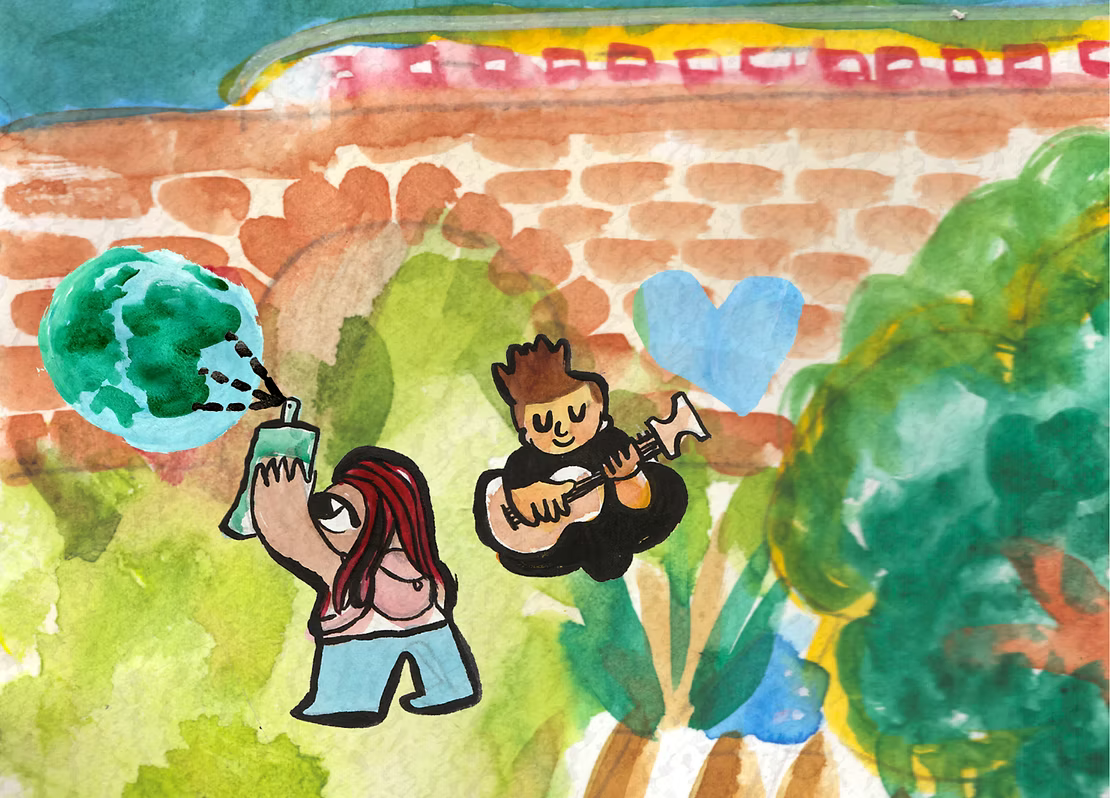
Illustration by Charlotte Bailey
The stories we tell about the world are not separate from culture – they both shape and are our culture.
This may seem self-evident but this truth is not systematically acknowledged within some of our most influential storytelling spaces: newsrooms.
For too long, traditional newsrooms have trained journalists to see reporting as neutral, ‘objective’ or somehow detached, when in reality it actually encodes the dominant ideologies at play – the ones integral to shaping the culture around us. Increasingly, we’re seeing how these dominant ideologies are not serving the great majority of us well.
Every time our news outlets report on stock prices but not on worker wages, our existing crises are reinforced. The status quo is protected when we report on how much tax you can save rather than what our taxes enable. We create a combative, dehumanising and harmful culture every time we describe any human as “illegal” (which technically is something no human can actually be).
Yet this doesn't have to be our future. The key to shifting our culture is to shift our stories. This is a lesson for journalists but also for the storyteller within all of us.
“If culture is all that we believe, value, do, and create, then cultural power is the ability to shape what we believe, what we value, what we do, and what we create. It is the power to decide what imaginary shapes our society.” This powerful articulation by Aisha Shillingford, an artist with Intelligent Mischief, is the reframe we need.
The first step toward a culture shift is to start where the tide is already rising: what’s already happening in sub-cultures, counter-cultural spaces and movements. If we want to seed generative and life-giving stories, we need to work with existing generative and life-giving practices.
The People’s Newsroom brought together several storytelling organisations in the UK to learn how these life-giving practices can help us transition to new economies on a liveable planet.
A key lesson from those practicing generative storytelling is: creativity catalyses regenerative culture. Stories are the manifestation of our creativity. They build the culture and momentum for change, within us and in the world.
From Opus, our host organisation based in Sheffield, we learned about their history as a cultural events organisation and their commitment to blurring the lines between independent media, culture and news. For example, their River Dôn Project works with local community members to reconstruct relationships to land within the river catchment. This has involved art installations, poetry workshops and interviews in Now Then Magazine which try to evoke what that relationship could look like, alongside more conventional reporting on river health and the failings of the local privatised water company, Yorkshire Water.
From GALWAD, a National Theatre Wales project, we learned how you can invite community members to “world-build” and imagine what a future would look like if we protect those future generations, now. The result was an immersive storytelling experience where the world of 2052 was brought to the present for seven days of news, video, live performance and events across Wales, reaching an audience of 5.4 million people.
It’s with Hood Futures Studio (formerly known as MAIA), an infrastructure and cultural movement of Black imagination and liberatory futures in Birmingham, built 'from and for the ends', where we dive a little deeper.
Tianna Johnson, Hood Futures Studio’s Communications Lead, already leads the frame differently: they don’t talk about themselves as a creator space, but as a cultural one.
“We are a community organisation,” says Tianna. “That doesn’t just mean we are an organisation based in a place. It means we are informed by the community we are in… those who come in and through it.” As a result, she says, “culture exudes from the space.”
Hood Futures Studio are setting out to build ‘ABUELOS’: what they describe in this piece as “a cultural centre with accommodation, as a site of radical hospitality and artistry.” They go on to say:
“The idea for ABUELOS was born – initiated as a cultural centre with accommodation, reimagining hospitality and the hotel model, in the abundant spirit of Grandad’s house. Like the radiating embrace of los abuelos (the grandparents), this is a place where the armchair is a stage, where debate is meaningful and mobilising, where laughter echoes through corridors adorned with art and artefacts, where the walls are exhibitions of those we love, where the lush gardens produce vegetation to nourish our bodies, the stories shared nourish our souls, and where wisdom is passed down through generations.”
Tianna says, “The Art Hotel isn’t about us, or this building. It’s about reimagining how we have a relationship with land, and how we let artists know their place in designing critical infrastructure.”
Critical to that infrastructure is putting art into everything, Tianna tells us. At Hood Futures Studio, every person has some kind of art background – even down to the HR lead. She goes on to explain how art shaped her world from a young age, more than any traditional news reporting ever could. Tianna says:
“My mom would be singing in the kitchen while washing the dishes: ‘Free Nelson Mandela’. I remember, I can hear it. That was critical for how she saw the world, for what made us move and act. We [Hood Futures Studio] want to ensure we are giving artists enough resources to make sure they create the work that makes us act – especially work that is life-affirming about people in Birmingham”.
Questions we’re asking now:
How can we unlock the creativity within us and expand the rather limited, and often uncreative, boundaries of journalism? – Megan Lucero
How can we support people in 'non-creative' organisational roles, like finance or HR, to use their knowledge and skills more creatively? How can those of us who are a bit more tapped into our creativity at work help them tell new stories about what their work is for, or about? – Debs Grayson
How does creativity either help or hinder our ability to tell trustworthy stories about the real world? – Shirish Kulkarni
This piece is a reflection of the learnings and insights shared in dialogue with the People’s Newsroom community. It was curated and written down by Megan Lucero and shaped by Debs Grayson and Shirish Kulkarni, edited by Sam Gregory, and produced by Phia Davenport.
This piece is part of a series, Lessons for a Story Commons. Aside from the introduction, How storytelling can open the door to thriving futures, the series can be read in any order: