
A history of Now Then since 2008, part three: a return to print
As the magazine prepares for a return to print, we look back at its evolution over nearly two decades with two of the people who were there from the beginning.
Our Sheffield-based community media platform, Now Then, recently announced long-awaited plans to return to print later this year. Here on the Opus Blog, we thought we’d look back at the history of the magazine with two of the people who were there from the start (or near enough): magazine editor-in-chief Sam Walby and long-time Opus director and writer Sara Hill.
In part one I spoke to Sam and Sara about how Now Then got started and in part two, we explored how the magazine evolved over its first twelve years in print. In this final instalment we take a look at the exciting plans to relaunch the print edition later this year.
Did the political aspect of the magazine get more important over time?
Sara: I think it was always defined from the start as something we wanted to do, and I think it was in there from the start. But obviously you don't make any money out of that. At the beginning we were all working for free, apart from our magazine designer, who was underpaid for the role he was doing. For a really long time we were all working loads of different jobs and volunteering for the magazine, so we always had that thread in it. But the day-to-day work was like, right, we're going to print in 21 days and we don't have enough money to pay for the print bill. So how are we doing that?
What are you working on that excites you most?
Sam: During Covid, we had a chance to pause and look at what we’d built, the networks we'd established, and say, let's find some more intention and coherence around this. So the thing that excites me most is, how do we think of Now Then as just one of a number of projects, platforms, and ways of working that we can apply to different topic areas? We can bring to bear all these things in a really focused way to look at the food system in Sheffield, or to look at important things that are happening in communities. It’s trying to be more directional, more propositional, without losing that sense of agitation, that sense of expression of anger at injustice, that’s really important. It was fuel for the fire for so many years, and I think it still is. But I think that's the thing that excites me most: how do those things connect in a really meaningful, coherent way, and how does a newly-launched print magazine fit into that menu of options we can draw on to produce meaningful ‘artifacts’ and meaningful work?
I suppose that takes us to the top-level ambitions. We spent a long time being really clear about what we were against: against monoculture, against cuts to the things that make our city unique, interesting and great. Really it's only in the past few years that we've started to be clearer with our partners, with people in the city, and with ourselves about what we're actually for. I don't think we necessarily have a nice, neat answer to that question yet apart from a more collaborative city: a place where people can flourish, be connected, and have space to explore possibilities. What space can we nurture for conversations that are looking at the future of the city, and looking at transition towards futures that are more livable? How do we hold the grimness of some possible scenarios with the possibilities for what we could do significantly differently here? How do we support that without being too presumptuous or too imposing of the way we at Opus see things?
How do we encourage people to turn that anger towards something collaborative, something constructive, without losing an agitation against things that are wrong and how we're all part of perpetuating those? Really, systems are just collections of interactions, habits, procedures, policies, laws. But a lot of it lives inside us, in the way we conduct ourselves.
How can a revived print magazine explore some of these issues in a way that's still engaging and that will make people want to read?
Sam: I think it comes back to that challenge you always have in trying to co-design things. How much can you design for, and how much do you have to see what emerges? I think the role we've played recently in Opus is to get people and institutions to try to widen the lens of how they’re looking at those things.
You have to have a feeling that things aren't working well, that there's injustice, and you have to make space for that – you can’t remove people's actual lived experience. So I think it's about getting in the weeds together on a lot of these issues, and how people are experiencing them. It's not necessarily to then say, ‘Oh, the thing you're experiencing is a manifestation of this system’. It's just finding different means of expression for those things, and trying to be quite playful and generative with what we do with that. We know from the work we do and the stories we put out in the magazine that there's so much energy and initiative being taken in so many areas in the city.
It feels like there’s more of that energy in the city than there was five or ten years ago.
I think so. A cornerstone of a lot of what we've been doing at Opus since the pandemic is saying we can't look at food separately from housing, or energy, or any of these other systems. So I think there’s an encouragement for people and organisations to step out of those silos. It’s trying to find connectivity between some of those things, and making that feel real – hopefully in a way that doesn't feel like it's imposing a particular shared narrative or an artificial coherence.
The climate – politically, socially, however you want to describe it – in Sheffield, is very different, particularly since the pandemic. Obviously we've had some key moments that have defined that, like the street trees debacle, like the impact Covid had on people and organisations in the city, and Black Lives Matter. Some of these things are national or international, but there’s a sense of emergent possibility that I didn't feel a few years ago. People in organisations are looking for some coherence, some connectivity. How do you do that in a way that doesn't flatten how diverse and how much of a plurality there is of things happening in the city?
What are you most excited about in terms of a return to print?
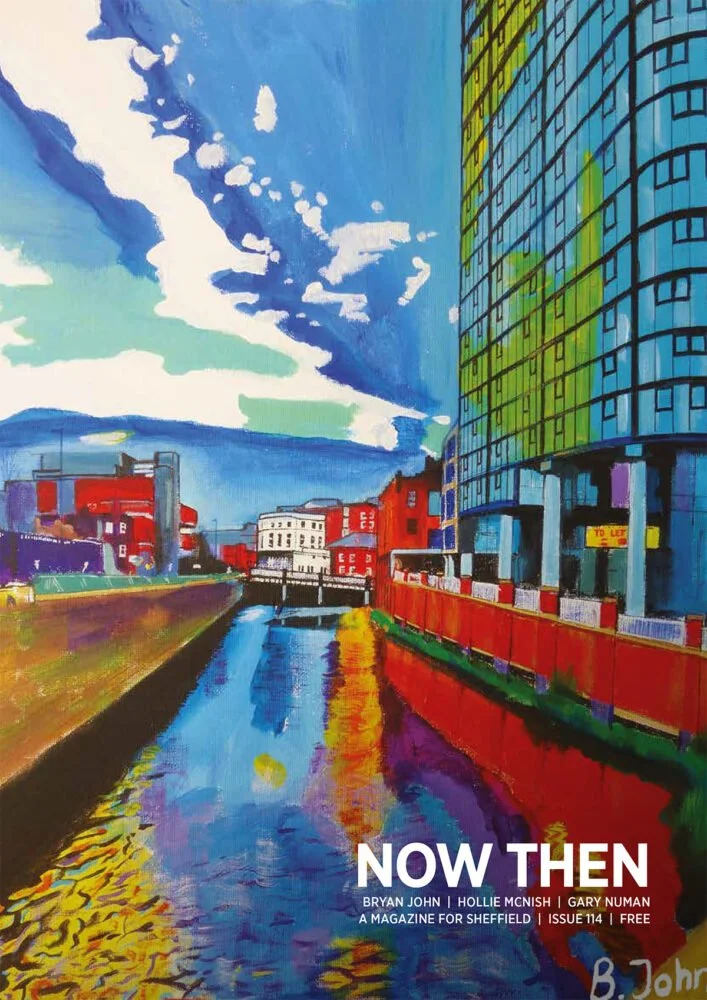
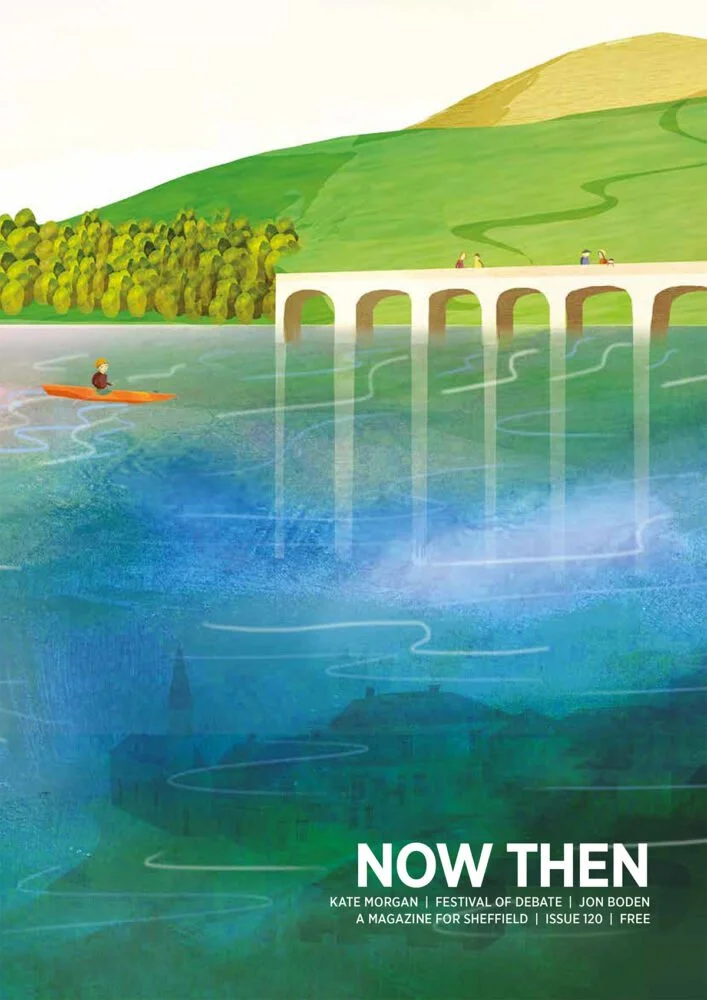
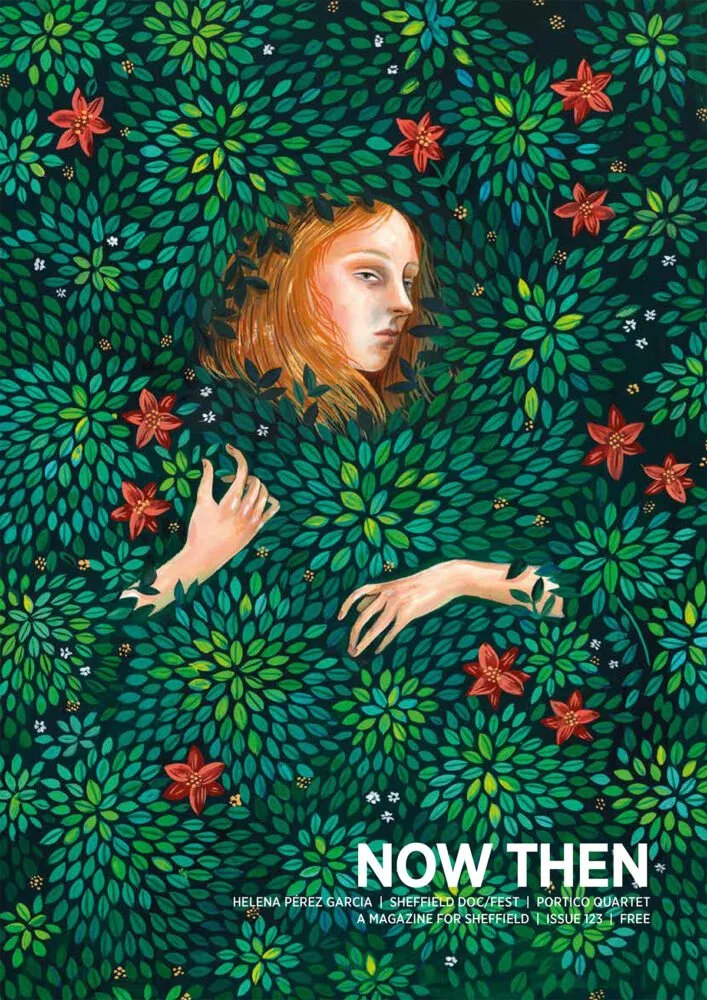
Sara: I feel like the thing that suffers most from it being online is the artwork. Although obviously we still feature visual artists, the digital medium for that is just so different. At The Cremorne on London Road, all the backs of the benches you could see from its front window all the way around the pub were just covered in artwork they'd taken out of Now Then.
The Rutland used to have their favourite bits of political art up. You'd walk into cafes and just see these brilliant pages of art that people had ripped out of the magazine – maybe it seems a bit weird as a producer of a magazine to say I quite liked it when I saw people had ripped it up! But I feel like that way of engaging with the art and making it accessible and something that people could share – I'm really excited about that.
And the changes that we've experienced within the wider Opus team since Now Then went out of print in 2020, I'm really excited to see how we translate those into a print magazine, because I think we've done it with the online magazine in terms of the type of stories we're telling and the investigations and so on. I'd really like to see that in print, because I think that work’s been amazing but it reaches fewer people in the online space. The art always felt like a good gateway and a bridge for people who might not pick up a politics magazine, but they would pick up an art magazine, and vice versa. It felt like a really important bridging of audiences and communities. I'm excited for that.
What do you want or need from the community to take those next steps in terms of bringing back the print magazine?
Sam: We’ve put out into the world that we want to go back to a printed magazine. We'd like to do a bigger splash with that, at a point where we feel a bit more confident about what the plan is – we're working through the gears.
I suppose what I want or need from people who are excited by everything we just talked about, and from readers and contributors of the magazine, is a willingness to join us on a journey where we're trying to think a lot bigger about what the mag can do, and how the printed magazine could look radically different and have different intentions, while keeping some of the spirit of the thing we all know and love.
It was really popular, the print magazine. It's the thing we've heard most commonly from people: when are you going back to doing a printed mag? So I guess what we need from people is a curiosity and a willingness to engage on a deeper level, and go on a bit of a journey of discovery with us about what the print magazine can contribute, above and beyond being a platform for good and important stuff in the city, which of course it still will be. I'd love to see people step into the invitations that we can offer out.
It’s going to be asking more of people isn’t it – both readers and contributors.
Sam: Yeah, I think some of that is in how we might frame the printed magazine – what its purpose is – when it comes back.
We've talked a bit about the permanence of a magazine being a break from the quick-fire digital world that a lot of us live in and get our information from. It’s just an invitation to slow down, to sit with things and to realise that when we're completely overloaded with information we don't always make the space to actually try and make sense of things and what it means for us and the city.
It’s important to remember, when we hear all these things about our attention spans and the effect social media or AI is having on our cognitive abilities, that we've been hacked. It’s about remembering that and not turning that on ourselves, and just thinking we're incapable and we don't have agency, that we're just vessels for serotonin. It’s about sitting with things that don't have an easy answer, that have a lot of tension in them, and that have a lot of different truths in them.
Those aren't things we're encouraged to do online at all. Because whether it's something we find really exciting and stimulating, or something that provokes outrage and anger, those emotions are important, valid and can be harnessed – but they're often not invitations to make sense of stuff together. I think that would be the invitation we’d want people to take up.
Finally, what’s the best thing that could happen?
I think the magazine being part of a wider ecosystem of connection, activity, thinking and making sense of stuff, and it becoming something that a greater number of people have more of a say in where it goes, what’s in it, what it's for. And a recognition that it's not just a platform, it's not just a way of broadcasting information or opinions.
Again, those things are important – we want people to be well informed. But the problems that we're facing today as a city, in communities, as a society, are not due to a lack of information. They're due to a lack of ability to work out together what information is important and how we can act on it.
I think it’s about the magazine becoming part of a shared practice with people and organisations in the city, whoever wants to be involved in that, and that the platform is just one way that activity is reflected back to a wider group of people in Sheffield.