

In a story commons, we envision new economies
This piece is part of our ‘Lessons for a Story Commons’ series. These lessons emerged from a group of creatives who gathered to share examples and prompts for shifting the way we tell stories. Read more about this process, and the transition we’re working towards, in our introductory piece.
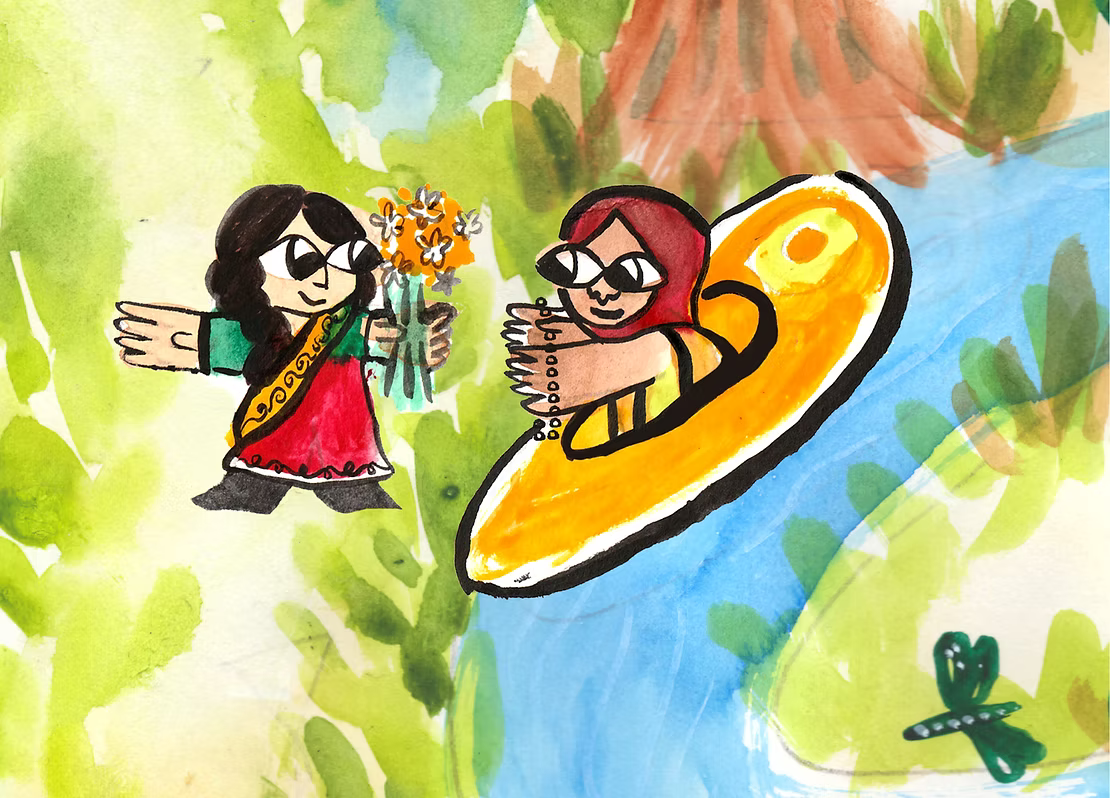
Illustration by Charlotte Bailey
What could a different relationship between storytelling and economics look like?
In mainstream economics, stories are irrelevant to how economies function. Economics is usually presented as a question of numbers, mathematical models and blunt facts about the world. And at the centre of these models is ‘economic man’, whose sole motivation is trying to maximise utility and get the best price for everything – he certainly doesn’t dream or tell stories. No wonder economics is known as the ‘dismal science’.
On the other hand, for heterodox economists – people who think about how economic systems work in a more expansive and social way – stories are intrinsic to how economies function. ‘Economic man’ himself is a story – a narrative that arguably justifies extremely antisocial behaviour as both rational and inevitable.
Another powerful story within mainstream economics is ‘the tragedy of the commons’, told by Garrett Hardin in his famous paper of 1968. He bases his whole argument on a story about people who try to share a piece of land, but end up destroying it because they each pursue their own interests. Hardin literally pulled this out of his imagination – he didn’t try participating in a commons, or bother speaking to anyone who knew what it might actually be like. Yet this story has been referenced thousands of times since as ‘evidence’ that if we don’t have private property (backed up by a powerful state), we’ll end up living in a wasteland.
Now it’s become clear that private property backed by the state is destroying our shared resources, there’s an urgent need for different kinds of stories that can teach us different kinds of lessons. Stories that affirm the possibilities of commons and commoning, and how our futures can be regenerative rather than extractive and destructive.
In her book Doughnut Economics, Kate Raworth talks about how the stories which are central to mainstream economics are often told through pictures. Images like the never-ending growth curve create and perpetuate ideas about how an ideal economy should function. In response, she created her own image depicting the economy as a doughnut to bring into view elements that go missing from these mainstream images.
It depicts two rings, the inner one being a baseline for meeting the human needs of everyone on the planet and the outer one being the ecological ceiling that needs to be maintained to remain within environmental limits. The doughnut depicts a different vision of where we should be heading: not for perfectly efficient markets or endless growth, but existing within the ring of the doughnut – the safe and just place for human flourishing.
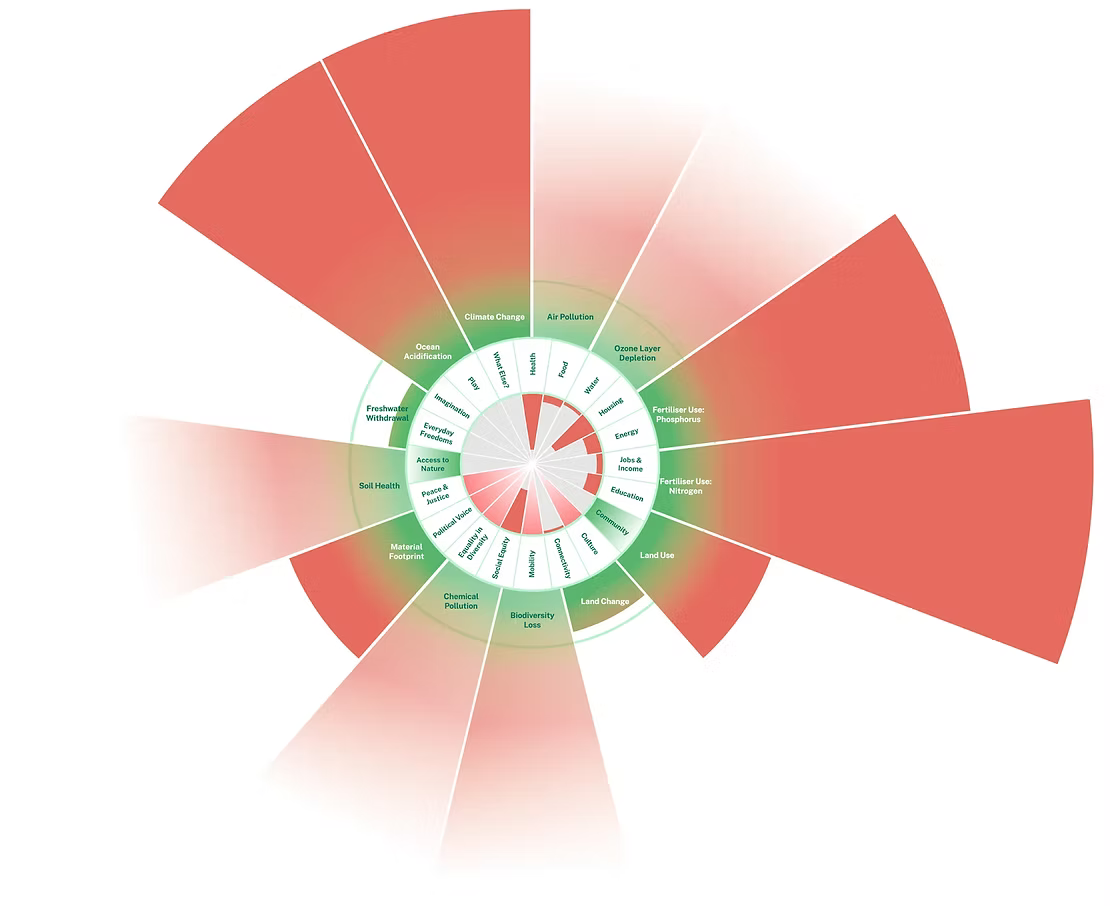
One of the organisations in our first storytelling cohort was CIVIC SQUARE. They’re a social enterprise based in Ladywood, Birmingham that aims to create neighbourhood-scale civic infrastructure for social, ecological, economic, and climate transition. CIVIC SQUARE has been using Doughnut Economics as a way of having conversations about what the neighbourhood could look like and how its economy could work differently. As Byng told us:
“A lot of this work with the Doughnut is around setting a new goal. What does it mean to go from GDP growth to something else, a way of thinking about the economy that has a wider understanding of the symbiosis between human flourishing and ecological safety? The current economic paradigm governs so much of how we live and we need to actively orient away from that – but towards what, and how do we do that together rather than going in different directions? The Doughnut allows for lots of different things to be true together, and it helps us have conversations about what it would mean to have a new goal of balance rather than growth.”
CIVIC SQUARE are using the Doughnut in lots of different ways – for example, they've used it to inform the design of a building that will act as their community hub. But it’s also been built into fun and creative activities involving storytelling. One project involved working with some local storytellers, led by Zoya Ahmed and Khadijah Carberry, who decided to introduce kids to the ‘planetary boundaries’ through a character of a super worm trying to defend the health of the soil and the planet.
“It was a way to get into these ideas using imagination practices – not just understanding the boundaries but also getting people to imagine themselves as taking on the role of being a defender and protector. So there’s a different relationship there, not just seeing the boundaries as negative ‘spending limits’ but recognising all the amazing things that are made possible when we stay within those limits.”
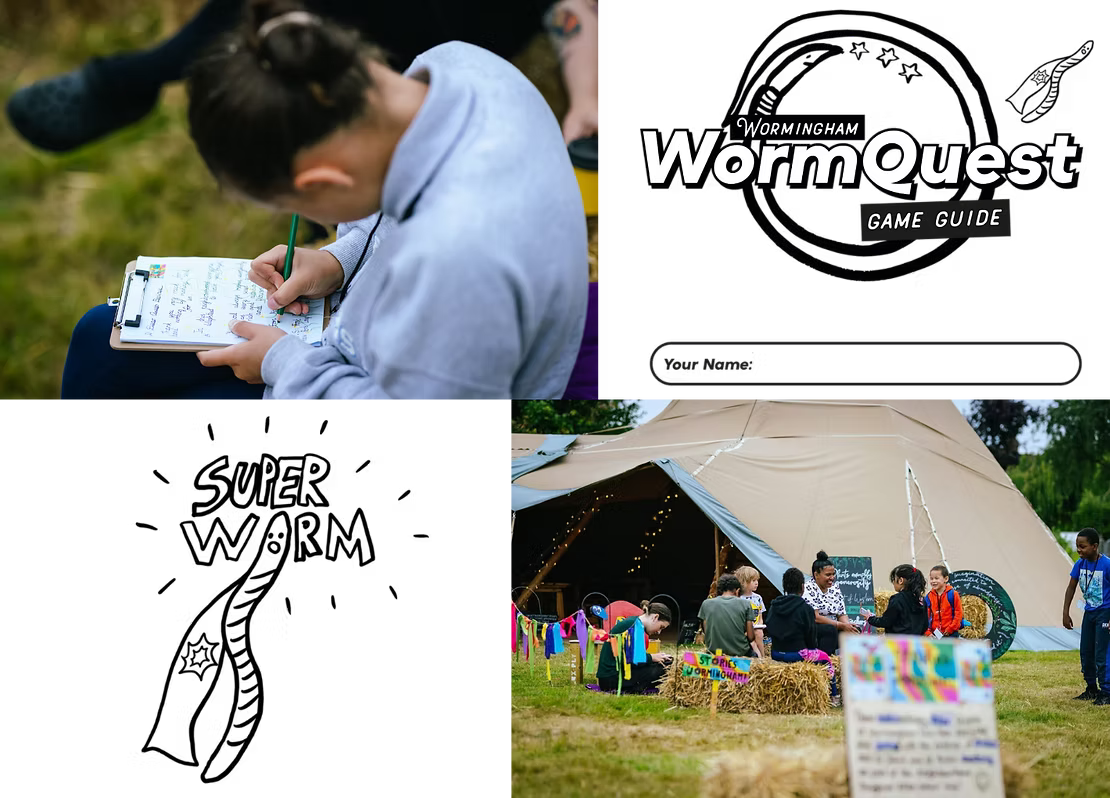
Credit: Thom Bartley & Angela Grabowksa
While storytelling can help new economic systems flourish through their content, Byng also sees another set of connections:
“I’ve become interested in how sharing stories can inform how other kinds of capital can move. At the moment, financial capital seems to inform how we expect stories and other things will be shared. As we face up to material constraints, and have to reduce our use of material things, there will be a big role for storytelling in helping us discover new immaterial abundances, and in helping us recognise the abundances that are already there. In that context, the ways we share and distribute stories could be a model for how other kinds of capital move, helping change what we expect and where we get our sense of abundance from. Storytelling, craft, collective intelligence and knowledge sharing will all become more important – placing more value on things that have been playing second fiddle to finance and profit.”
I found CIVIC SQUARE's work really inspiring – and while it’s specific to its place and neighbourhood in Birmingham, I think there are wider lessons for anyone interested in how stories can support the transition to a world where we all live in the ‘safe and just space for human flourishing’.
First, there's a real need to repair the relationship between storytelling and ‘the economy’. Economics is a part of life, not a separate arena that only economists can understand. When talking about obviously ‘economic’ issues, this might mean refusing framings that treat GDP as a good in itself, promoting heterodox economists like Raworth, or looking critically at local growth plans based on fossil fuels or arms manufacturing. But it also means telling stories about how economies can and do work differently, and telling those stories in imaginative and compelling ways. Economics is about how we live together, and it involves all of us – including the creative, dreaming and storytelling aspects of ourselves.
Second, stories can help guide us to new economies through their content – inspiring us to take care of the soil, or to believe that people can share resources without destroying them. But they can also guide us through the ways they’re produced and shared. The act of coming together to talk about what Doughnut Economics could mean, the process of developing the neighbourhood portrait, and the involvement of children through activities like super worm, all imply a very different idea of what an economy could be and how power should be held in it.
For storytelling commoners, grounding our stories in collective spaces and practices is part of living out this different vision. Can the way we tell stories of new economies bring to life what it would feel like to meet our shared needs in collective, responsible and joyful ways?
Questions we’re asking now:
How might we use creativity and storytelling to make economic systems more transparent? – Shirish Kulkarni
What would it look like to shift from hedge fund and philanthropically-funded media to a media that’s part of a solidarity economy? – Megan Lucero
This piece is a reflection of the learnings and insights shared in dialogue with the People’s Newsroom community. It was curated and written down by Debs Grayson and shaped by Shirish Kulkarni and Megan Lucero, edited by Sam Gregory, and produced by Phia Davenport.
This piece is part of a series, Lessons for a Story Commons. Aside from the introduction, How storytelling can open the door to thriving futures, the series can be read in any order: