

In a story commons, we reimagine accountability and care
This piece is part of our ‘Lessons for a Story Commons’ series. These lessons emerged from a group of creatives who gathered to share examples and prompts for shifting the way we tell stories. Read more about this process, and the transition we’re working towards, in our introductory piece.
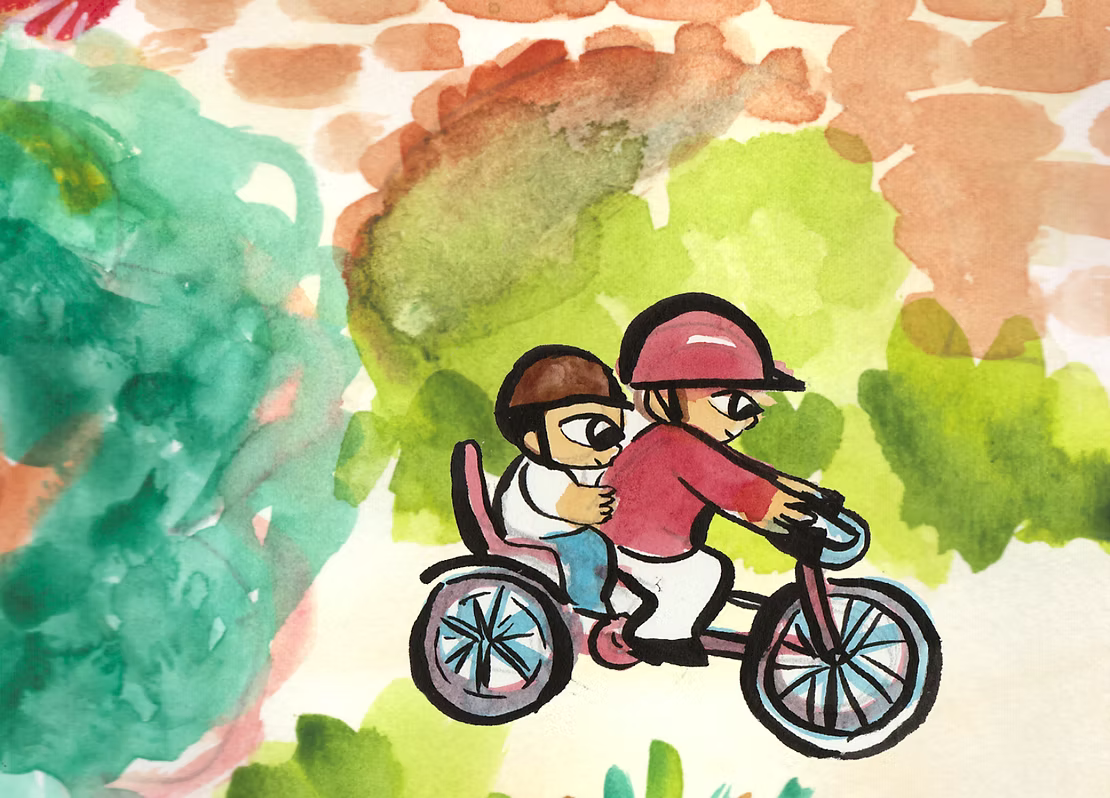
Illustration by Charlotte Bailey
“Accountability is a discipline, not a fixed destination.”
Say it again, slower this time.
Accountability is a discipline. It is not a fixed destination.
Even writing this I feel myself trying to evoke an idea that is finite, fixed, certain. Try not to let it be. Try to listen to what is reacting in you when you hear this, to what this wisdom evokes from the past, what you’re beginning to imagine in the future, what feels all too real in this present moment.
This provocation comes from Hood Futures Studio (formerly known as MAIA), an infrastructure and cultural movement of Black imagination and liberatory futures in Birmingham, built 'from and for the ends'. They outline how they approach accountability in their powerful piece: “What does it mean to grow an infrastructure of care?”
The People’s Newsroom collective invited Hood Futures Studio to speak to this piece, how the organisation brings this to life through their storytelling and, crucially, how care and accountability are woven into their work. Hood Futures was one of several storytelling organisations we brought together in the UK to learn how we can transition to new economies on a liveable planet.
A key lesson we learned together was that care and accountability are nurtured collectively.
Stories are ongoing acts of care that invite us into collective participation, governance and transformative justice.
As a group, we looked at how traditional journalists proudly say their role is to ‘hold power to account’, and yet systematically fail to do just that. ‘Success’ is seen as having a corrupt politician quit or be fired, not changing the conditions that enabled the corruption in the first place.
Influential storytellers of our moment evoke a ‘cancel culture’, a ‘punishment culture’, a ‘policing culture’ – not cultures that enable participation, healing, forgiveness, evolution, and transformation at individual, community and national levels.
Finally, we also fail to raise these very points as an industry. We say we want to hold power to account, apart from the power that we, the media, hold. There are few mechanisms to critique and redress the harm of our influential media outlets as they perpetuate transphobia, genocide and racism, to name a few.
Greater Govanhill, a community newsroom in Glasgow, shed a light on what this looks like in practice. They’ve created relational accountability with their community through the very way they operate. Greater Govanhill is “created by local residents of Govanhill to challenge negative stereotypes, break down cultural barriers, and bring people together while providing a space to learn new skills and share resources.”
They support local citizens to tell stories in their own words, they centre underrepresented voices, and they even have a physical community newsroom to support “connection as well as information needs”. They provide an ongoing, relational way of approaching the stories they tell and how they tell them, and they also opt in to regulation.
Greater Govanhill are also a member of IMPRESS, the UK’s independent press regulator. IMPRESS invites publications into a modern and ethical standards code, and supports ethical journalism accreditation and alternative dispute resolution. This becomes the formal and independent backstop for them in cases where relationships have really broken down.
Hood Futures Studio say, “It is easy to drift into care and caring as transactional endeavours, as something that you are either the provider or the recipient of, rather than reciprocal and abundant flows of exchange.”
We acknowledge this strong, gravity-like force pulling us into transactional care and accountability. We live in a world where for-profit companies, and even our governments, see themselves as separate from the community.
Critical to this is how they see accountability as separate to care. If we want to orient our stories, our mechanisms and our structures towards a more generative future, we must also establish radical new forms of accountability and care to nurture it.
Hood Futures Studio have articulated new ways of describing and evoking accountability. They say:
Accountability is a pull from within, it should not be punitive or imposed from the outside
Accountability is a discipline, not a fixed destination; it is found and crafted in the process
Accountability to our mission (and its wider context) is what enables autonomy and agency
Accountability is boundaried vulnerability and honesty, where we understand our entanglements and can walk beside one another (at different paces if needs be)
The group have since written about accountability, care, radical hospitality and urgency in “an era marked by displacement, dispossession, misinformation, and rising fascism”. Their shift from the name MAIA to Hood Futures Studio is an example of how their creativity and accountability to their community is in constant evolution.
As we imagine what a future storytelling commons might look like, these descriptors of accountability feel central. Yet it doesn’t mean that harm won’t happen. We envisage a different kind of storytelling that addresses difference, tension and societal harms in small and meaningful ways, so they don’t lead to drastic harm and redress.
To do this, we need to acknowledge that the harms we experience as individuals are in fact collective harms we've enabled as a society. Therefore our healing must be collective too. We believe storytelling could play a role in our collective healing. We picture small, regular acts of care, through narrative transformation, that invite us into collective participation, governance and transformative justice.
New kinds of storytelling put community care and wellbeing at their core, and can generate a desire to act ethically and responsibility on behalf of the collective. Deep, relational storytelling work can invite people back into relationship with the community when they step outside the values they share with their neighbours. This can be a deeply caring process in which we support one another to act responsibly and must be led by those marginalised by current systems who are most attuned to how and when harm is taking place.
Questions we’re asking now:
How might storytelling help us shift from accountability attached to shame, exclusion and 'cancelling', to an invitation to be included and responsible to our communities? – Megan Lucero
I’m wondering about how demands for ‘care’ can be weaponised and sometimes get in the way of accountability. How can we discern when people are acting in good faith, with genuine intention to learn and do better? What kinds of stories and ways of telling them can help us be more discerning? – Debs Grayson
As storytellers, who are we accountable to? – Shirish Kulkarni
This piece is a reflection of the learnings and insights shared in dialogue with the People’s Newsroom community. It was curated and written down by Megan Lucero, shaped by Shirish Kulkarni, Debs Grayson, edited by Sam Gregory, and produced by Phia Davenport.
This piece is part of a series, Lessons for a Story Commons. Aside from the introduction, How storytelling can open the door to thriving futures, the series can be read in any order: